(718) 249-7447
 Call Us Now


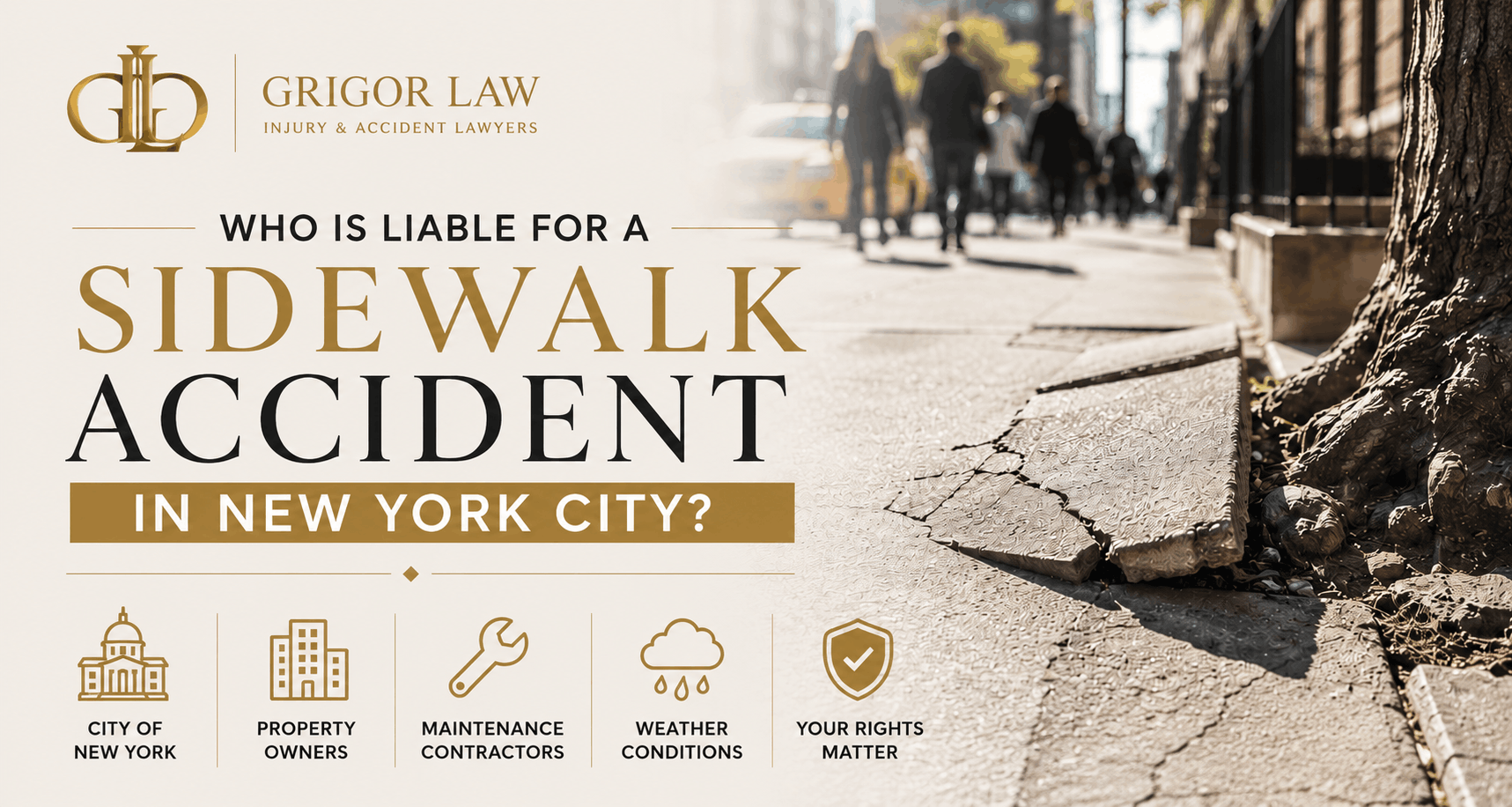
If you fell on a broken or icy sidewalk in New York City, the property owner next to that sidewalk is usually liable for your injuries under NYC Administrative Code §7-210. In most cases, this means the building owner or business must pay for your medical bills, lost wages, and pain and suffering. The City of New York can also be responsible in specific situations, such as sidewalks next to small owner-occupied homes or when City-controlled features like tree roots or utility covers cause your fall.
Understanding who is liable for sidewalk accidents in NYC involves knowing the complex rules about property ownership, maintenance duties, and legal deadlines that can make or break your case. This guide explains exactly who you can sue after a sidewalk fall, what evidence you need to prove your case, and the strict time limits that apply to different types of claims.
We’ll also cover what compensation you can recover, how to protect your rights immediately after an accident, and when you might still have a case even if you were partly at fault.
Who Is Responsible for a Sidewalk Accident in NYC?
In most cases, the owner of the property next to the sidewalk is liable for a sidewalk accident in New York City under NYC Admin Code §7-210. The City of New York may be liable in limited situations, such as when the sidewalk borders a one-, two-, or three-family owner-occupied home.
You might also be able to sue a tenant, business, or utility company depending on what caused your fall. Understanding who is liable sidewalk accident New York City cases helps you know who to hold accountable for your injuries.
Who Maintains NYC Sidewalks Under Administrative Code Section 7-210?
NYC Administrative Code §7-210 is the law that shifted sidewalk responsibility from the City to most property owners in 2003. This means the owner of the building next to where you fell is usually responsible for keeping that sidewalk safe.
The law requires property owners to handle several key duties:
- Repair cracked or broken sidewalk slabs: Property owners must fix any dangerous conditions that could cause someone to trip.
- Clear snow and ice after storms: Owners must remove snow and ice within specific time limits after weather events end.
- Maintain a reasonably safe surface: This includes fixing tree root damage, filling holes, and replacing broken concrete.
- Carry liability insurance: The law requires property owners to have insurance that covers sidewalk injuries.
This duty cannot be transferred to someone else. Even if a property owner hires a snow removal company, they remain legally responsible if someone gets hurt.
When Is the City of New York Liable?
The City of New York is still responsible for sidewalk injuries in specific situations. These exceptions to the general rule matter because suing the City requires different procedures and much shorter deadlines.
When a sidewalk borders a one-, two-, or three-family owner-occupied home, the property owner is generally exempt from §7-210 liability, and the City may be responsible if it had notice of the defect or created the dangerous condition. The City is also responsible for sidewalks adjacent to parks, public schools, and government buildings.
Key City-Controlled Areas That Cause Falls
Even when a private owner maintains the main sidewalk, the City keeps responsibility for certain features:
- Tree wells and surrounding areas: The City plants and maintains street trees, making them liable for root damage.
- Curbs: These are legally separate from sidewalks and remain under City control.
- Pedestrian ramps at crosswalks: The City designs and maintains these accessibility features.
- Defects created during City work: If City crews damage a sidewalk during street repairs, they become liable.
Prior Written Notice Requirements for City Claims
To sue the City, you usually must prove it received “prior written notice” of the exact defect before your accident. This means someone filed a formal complaint about that specific hazard, and the City failed to fix it.
There are two important exceptions: when the City created the dangerous condition itself, or when the City made special use of the sidewalk area. Missing the strict deadlines for City claims can end your case permanently.
Can a Tenant or Business Be Liable for a Sidewalk Fall?
Yes, businesses and tenants can be held responsible for sidewalk accidents even if they don’t own the building. This happens when the business created the hazard, made special use of the sidewalk, or accepted maintenance responsibility in their lease.
Commercial tenants like restaurants, stores, and offices often become liable when they cause dangerous conditions. A restaurant that spills grease outside or a store that leaves merchandise on the sidewalk creates liability for themselves.
Common Special Use Situations
“Special use” means using public sidewalk space for private benefit, which creates a duty to keep that area safe:
- Basement entrances and cellar doors: Metal doors or grates built into the sidewalk for building access.
- Driveways cutting across sidewalks: Vehicle access points that interrupt the normal sidewalk surface.
- Outdoor dining areas: Tables, chairs, and barriers placed on public sidewalk space.
- Loading zones and delivery ramps: Permanent structures used exclusively by one business.
Utility Company Responsibility for Covers and Grates
Con Edison, Verizon, National Grid, and other utility companies own manholes, utility covers, and grates in sidewalks. If you trip on a broken or raised utility cover, that company is responsible for your injuries.
This responsibility includes the cover itself and the 12-inch area around it. Utility liability often gets overlooked but can provide another source of compensation.
What Sidewalk Conditions Lead to Successful Cases?
Not every crack or imperfection will support a lawsuit. The defect must be “unreasonably dangerous” to a pedestrian using reasonable care.
Courts look at several factors when deciding if a condition is actionable:
- Height difference: Vertical gaps over half an inch between sidewalk slabs often qualify as dangerous.
- Width and depth: Large cracks or missing chunks of concrete create trip hazards.
- Visibility: Defects hidden by poor lighting, debris, or weather conditions are more likely to be actionable.
- Location: Hazards in high-traffic areas or near building entrances get more scrutiny.
| Sidewalk Condition | Usually Actionable? |
| Raised slab over ½ inch from tree roots | Yes |
| Large crack or missing concrete chunk | Yes |
| Ice accumulation hours after storm ends | Yes |
| Minor surface crack with level flags | Often too trivial |
| Hidden defect under poor lighting | Yes, even if small |
How Insurance Companies Fight Sidewalk Claims
Insurance companies use two main defenses to deny valid claims. The “trivial defect” defense argues the hazard was too small to be dangerous. The “open and obvious” defense claims you should have seen and avoided the hazard.
These defenses don’t automatically bar your case. An experienced attorney can show how even visible defects can be unreasonably dangerous under the circumstances.
What Must You Prove to Win Your Case?
Winning a sidewalk accident case requires proving four elements of negligence. Each element must be established with evidence and testimony.
You need to show:
- Duty of care: The defendant had a legal obligation to maintain the sidewalk safely.
- Breach of duty: They failed to repair a known hazard or clear snow within required timeframes.
- Causation: Their negligence directly caused your fall and resulting injuries.
- Damages: You suffered real harm including medical bills, lost income, and pain.
You also must prove “notice” – that the responsible party knew or should have known about the dangerous condition. This can be actual notice (someone reported it) or constructive notice (the condition existed long enough that they should have discovered it).
Critical Evidence to Preserve Immediately
The evidence you collect right after your fall often determines whether you can prove your case. Important evidence disappears quickly as conditions change.
Take these steps while evidence is still available:
- Photograph the defect from multiple angles: Use a coin or ruler to show scale and depth.
- Document your injuries and clothing: Take pictures of wounds and the shoes you wore.
- Get witness information: Ask anyone who saw the fall for their name and phone number.
- Note surveillance cameras: Look for security cameras on nearby buildings, ATMs, or doorbell systems.
- Preserve medical records: Keep all documentation from emergency room visits and follow-up care.
- Record the exact location: Write down the building address and take photos showing which property the sidewalk borders.
Your attorney can then obtain property ownership records, 311 complaint histories, and other official documents to prove liability and notice.
Strict Deadlines That Can End Your Case
Missing legal deadlines permanently prevents you from recovering compensation. New York has different time limits depending on who you’re suing.
Private property owners: You have three years from the accident date to file a lawsuit under New York’s general negligence statute of limitations.
City of New York: You must file a Notice of Claim within 90 days of your accident. After filing a Notice of Claim, other strict deadlines may apply for starting a lawsuit, so consult an attorney promptly.
Workers injured while working: Different deadlines apply under workers’ compensation law, often much shorter than personal injury claims.
The 90-day Notice of Claim deadline for City cases is one of the most important in personal injury law. Missing it usually ends your case before it starts.
What Compensation Can You Recover?
Sidewalk accident victims can recover compensation for all the ways their injury has impacted their life. This includes both economic losses you can calculate and non-economic damages for pain and suffering.
Your compensation may include:
- Medical expenses: All past and future treatment costs, including surgery, physical therapy, and medications.
- Lost income: Wages you missed while recovering and reduced future earning capacity.
- Pain and suffering: Compensation for physical pain, emotional distress, and reduced quality of life.
- Out-of-pocket costs: Transportation to medical appointments, medical equipment, and home modifications.
- Wrongful death damages: If you lost a family member, you can recover funeral costs and loss of financial support.
A skilled New York City slip and fall lawyer ensures every loss gets properly valued, not just your immediate medical bills.
Can You Still Sue if You Were Partly at Fault?
Yes, you can still recover compensation even if you were partially responsible for your accident. New York follows pure comparative negligence, which reduces your award by your percentage of fault.
For example, if you were looking at your phone when you tripped on a raised sidewalk slab, a jury might find you 20% at fault. You would still recover 80% of your total damages.
Don’t assume you have no case because you were distracted or not paying perfect attention. Many successful sidewalk cases involve plaintiffs who bear some responsibility for their accidents.
What to Do Immediately After a Sidewalk Fall
The steps you take right after a fall protect both your health and your legal rights. Quick action preserves evidence and strengthens your eventual claim.
Immediate Steps to Protect Your Case
Follow this sequence to give yourself the best chance of recovery:
- Get medical attention first: Call 911 or go to an emergency room. Your health comes before everything else, and medical records create an official injury timeline.
- Document the scene thoroughly: Take photos of the defect, surrounding area, and your injuries before anything changes.
- Identify the exact location: Note the street address and cross streets. Photograph the building the sidewalk sits in front of.
- Find witnesses: Get names and phone numbers from anyone who saw your fall happen.
- Report to property management: Tell the building owner or business manager what happened, but don’t give a recorded statement.
- Preserve your clothing: Keep the shoes and clothes you wore in a safe place as potential evidence.
- Avoid insurance adjusters: Don’t speak to anyone’s insurance company before consulting an attorney.
- Contact a lawyer quickly: Call a New York City personal injury attorney to preserve evidence and meet deadlines.
How Grigor Law Injury & Car Accident Lawyers Fights for Sidewalk Accident Victims
When you’re hurt because someone failed to maintain their sidewalk properly, you deserve aggressive representation that gets results. Grigor Law Injury & Car Accident Lawyers has built a reputation for fierce advocacy combined with genuine compassion for injured clients.
Chrissy Grigoropoulos founded the firm on the principle that everyone deserves access to top-quality legal representation.
We offer several advantages that matter when you’re facing insurance companies and property owners:
- 24/7 availability: Legal emergencies don’t wait for business hours.
- Free consultations: You pay nothing to learn about your rights and options.
- No fees unless we win: Our contingency fee structure means you only pay if we recover compensation.
- Multilingual service: We serve clients in Spanish, Greek, French-Creole, and Korean.
- Proven results: Our track record includes hundreds of satisfied clients across all five boroughs.
Don’t let a property owner’s negligence derail your life. Contact Grigor Law today for a free consultation and let us start fighting for the compensation you deserve.
Sidewalk Accident FAQ
Who Pays My Medical Bills While My Case Is Pending?
Your health insurance typically covers immediate medical treatment, and you may have coverage through New York’s No-Fault insurance if a vehicle was involved in your accident. Your lawsuit seeks to recover these costs plus additional compensation from the at-fault party.
What if I Fell During Active Snowfall?
Property owners are generally not liable for falls during active storms under the storm in progress rule. Their duty to clear snow and ice begins a reasonable time after the weather event ends.
What if I Was Working When I Fell on a Sidewalk?
Work-related sidewalk falls are primarily handled through workers’ compensation claims, which provide medical coverage and wage replacement. You may also have a separate personal injury claim against the property owner responsible for the dangerous sidewalk condition.
Does a Curb Count as Part of the Sidewalk?
No, curbs are legally separate from sidewalks under New York law. The City of New York maintains responsibility for curbs in almost all situations, even when private property owners are responsible for the adjacent sidewalk.
What Happens if I Missed the 90-Day Notice of Claim Deadline?
Missing the 90-day deadline to file a Notice of Claim against New York City usually bars your case permanently. Very limited exceptions exist for cases involving infants or people who were mentally incapacitated, but you should consult an attorney immediately to explore any remaining options.
Should I Keep the Shoes I Wore When I Fell?
Yes, absolutely preserve your shoes as important evidence. They can help demonstrate how your fall occurred and counter arguments that inappropriate footwear contributed to your accident.
How Do I Find Out Who Owns the Property Where I Fell?
Your attorney will identify the responsible property owner by searching New York City’s ACRIS database and other official records using the building address. This research is crucial for determining who to sue and often reveals multiple potential defendants.