(718) 249-7447
 Call Us Now


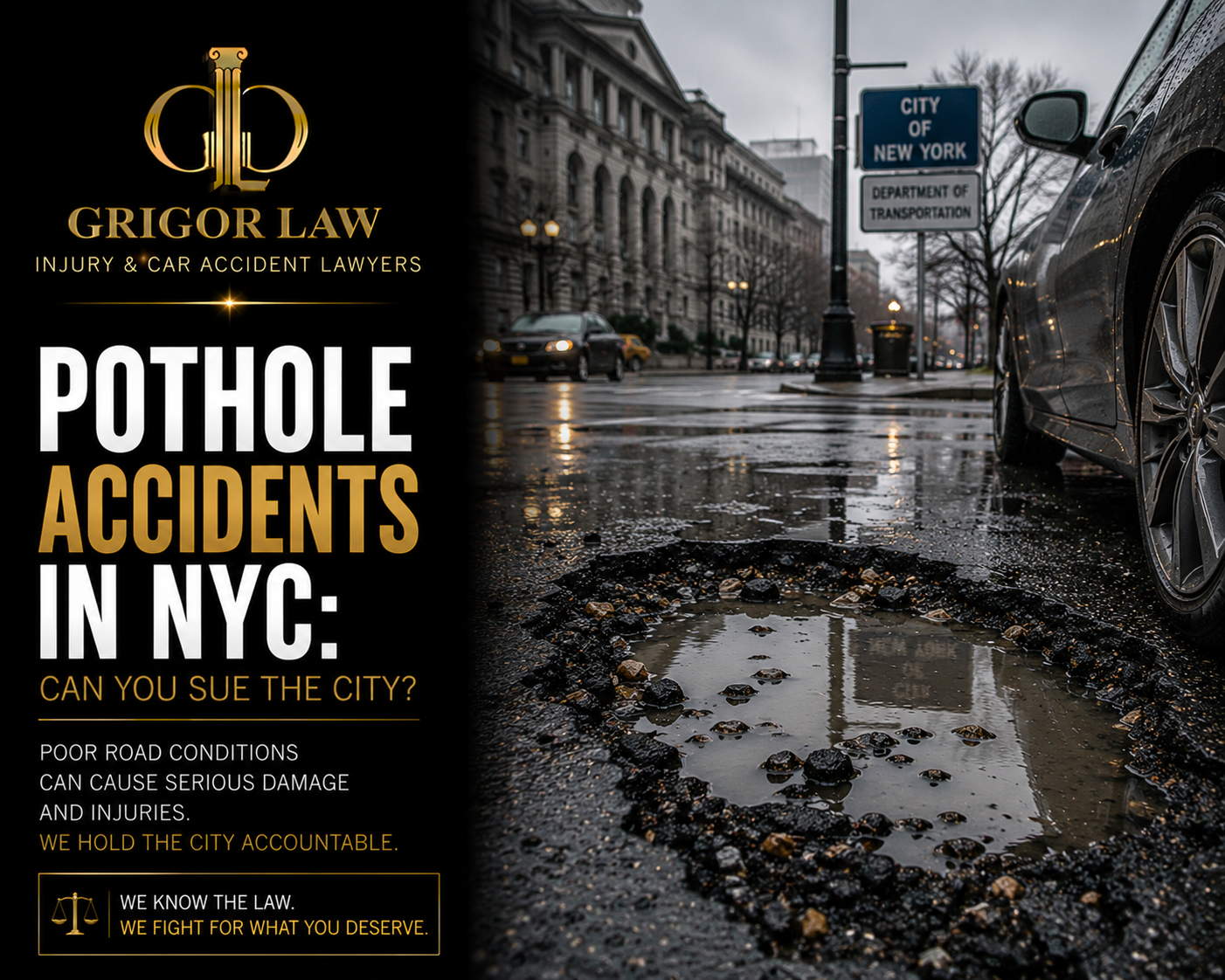
Yes, you can sue New York City for a pothole accident, but the process is more complicated than suing a private person or business. The City is protected by strict legal rules that limit when and how you can hold it accountable, and missing even one deadline can end your case before it begins.
This article walks you through exactly what those rules are, who is legally responsible depending on where the accident happened, and what steps you need to take right away to protect your claim. You will also learn what compensation you may be entitled to and why having the right legal team in your corner makes all the difference.
The rules are strict, but they are not impossible to navigate, and knowing them is your first step toward justice.
Can You Sue NYC for a Pothole Injury?
Yes, but there are strict rules that apply. To sue New York City for a pothole injury, you generally must prove the City already knew about the specific pothole and failed to fix it in time.
To win your case, three things must be true:
- Notice: Someone warned the City in writing about the exact pothole before your accident.
- Time: After receiving that warning, the City had time to make repairs, but no repairs are documented before the accident.
- Causation: That specific, unrepaired pothole directly caused your injury.
If all three apply to your situation, you may have a strong claim, and you deserve to know your options.
When Is NYC Legally Responsible?
NYC is legally responsible when a pothole on City-owned property injures you and the City had advance written warning of the defect. This requirement comes from Section 7-201(c)(2) of the NYC Administrative Code, commonly called the “Pothole Law.”
This law exists to protect the City from lawsuits over hazards it was unaware of. Understanding it is the foundation of your case.
What Is Prior Written Notice?
Prior written notice is a formal, documented complaint about a specific street or sidewalk defect that was submitted to the correct City agency before your accident. This means a phone call to 311 alone is often not enough; the complaint must be in writing and on record.
The notice could come from a 311 online submission, a City inspector’s report, or an entry on a civic survey map. You don’t have to be the person who filed it; your attorney just needs to prove that someone did.
Are There Exceptions to the Notice Rule?
Yes. Even without prior written notice, you may still be able to sue NYC if one of these exceptions applies:
- Affirmative creation: A City crew or contractor performed faulty repair work that immediately created the hazard.
- City hardware defects: The injury involved a manhole cover, sewer grate, or utility access point maintained by the City.
- Special use: The City installed a structure for its own benefit that caused your accident.
Who Is Responsible for the Location Where You Were Hurt?
Liability depends entirely on who owns and maintains the property where you were injured. Different entities, from the City to private landlords to the MTA, follow completely different rules.
| Location | Who Is Typically Responsible |
| NYC streets and crosswalks | City of New York |
| Sidewalks next to commercial or multi-unit buildings | The building owner |
| Sidewalks next to owner-occupied 1–3 family homes | City of New York |
| State highways (May 1 – Nov 15) | New York State |
| Subway grates and transit areas | MTA |
| Bridges, tunnels, airport approaches | Port Authority of NY & NJ |
Identifying the right defendant early is critical because each entity has its own deadlines and filing rules.
What Deadlines Apply to NYC Pothole Claims?
To sue New York City, you must file a Notice of Claim within90 days of your accident. After that, you have one year and 90 days from the date of injury to file the actual lawsuit.
These deadlines are much shorter than the standard three-year window for most personal injury cases in New York. Missing either one almost always means losing your right to compensation permanently.
What Is a Notice of Claim?
A Notice of Claim is a formal legal document that officially tells the NYC Comptroller’s Office you intend to sue. It must include the exact date, time, and location of your accident, along with a description of your injuries.
Vague descriptions like “near Jamaica Avenue” can get your case thrown out before it starts. Precision matters.
What Is a 50-H Hearing?
A 50-h hearing is a sworn testimony session in which City attorneys question you under oath about your accident and injuries before your lawsuit can proceed. It typically happens within a few months of filing your Notice of Claim.
You should never attend a 50-h hearing without a lawyer. The City’s legal team will use it to find inconsistencies they can use against you later.
What to Do Right After a Pothole Accident
Your first priority is your health and safety. After that, you need to act fast. Potholes are often repaired quickly after an accident, which can erase the evidence you need.
Document the Scene Before It’s Repaired
Take photos and videos of the pothole as soon as it is safe to do so. The more detail you capture, the stronger your case.
- Photograph the pothole from multiple angles to show its size and location.
- Place a coin, phone, or dollar bill inside the pothole to show its depth.
- Take wide shots that include nearby street signs or landmarks to confirm the exact location.
- Note whether any warning cones or barriers were missing.
Report the Condition to 311
File a report through the NYC 311 website or app right away. This creates a time-stamped, official record of the defect, which can help support your case even if you weren’t the first person to report it.
Get Medical Care and Follow Through
See a doctor immediately, even if your injuries feel minor. Delaying treatment gives the City’s lawyers an opening to argue your injuries came from something else entirely. Consistent follow-up appointments build a clear medical record that documents the full impact of your accident.
What Evidence Helps Prove Your NYC Pothole Claim?
Strong pothole claims are built on documented proof that the City knew about the hazard. Your attorney will work to gather the records that make your case undeniable.
- Your photos and videos from the scene are your most immediate and powerful evidence.
- 311 and DOT records can reveal prior complaints about the same pothole, establishing the written notice the law requires.
- The Big Apple Pothole and Sidewalk Protection Map is a civic survey submitted to the City that legally counts as prior written notice. If your pothole appears on this map, the City’s “we didn’t know” defense falls apart.
- Witness statements from bystanders, employees of nearby businesses, or others who knew about the hazard can significantly strengthen your claim.
What Compensation Can You Recover for Pothole Injuries?
If you were injured by a pothole, you may be entitled to compensation for every way the accident has affected your life not just your medical bills.
You can seek recovery for:
- Medical expenses: Emergency care, surgeries, physical therapy, and any future treatment you’ll need.
- Lost income: Wages you missed while recovering and any long-term reduction in your ability to earn.
- Pain and suffering: Physical pain, emotional distress, and the impact on your daily life and relationships.
- Property damage: Repair or replacement costs for your vehicle, bicycle, or other damaged belongings.
How Does No-Fault Insurance Affect Your Pothole Claim?
New York’s no-fault insurance system also called Personal Injury Protection (PIP) covers your initial medical bills and a portion of your lost wages after a car accident, regardless of who caused the crash. This means your own insurance pays first.
However, to sue NYC for pain and suffering, your injuries must meet New York’s “serious injury threshold.” A serious injury is legally defined as one that results in:
- A bone fracture
- Significant disfigurement
- Permanent loss of use of a body organ or limb
- Significant limitation of a body function or system
- Disability lasting at least 90 of the first 180 days after the accident
Do You Need a Lawyer to Sue NYC for a Pothole Accident?
Yes, and here’s why. The City Law Department has a full team of attorneys whose only job is to defeat claims like yours. Without experienced legal representation, most pothole cases never make it past the Notice of Claim stage.
A pothole injury lawyer handles the 90-day filing deadline, investigates DOT and 311 records, prepares you for the 50-h hearing, and negotiates directly with City attorneys. You focus on healing, we handle the fight.
At Grigor Law Injury & Car Accident Lawyers, we offer free consultations, are available 24/7, and work on a contingency fee basis, meaning you pay nothing unless we win. Our team speaks Spanish, Greek, French-Creole, and Korean, so no language barrier will stand between you and the legal help you need.
The 90-Day Deadline Is Real Don’t Wait
You have only 90 days from your accident to file a Notice of Claim against NYC. After that window closes, your right to compensation is almost certainly gone.
Contact Grigor Law Injury & Car Accident Lawyers today for a free, no-pressure consultation. We’ll review your case, explain your options honestly, and fight hard for the outcome you deserve at no cost to you unless we win.
Frequently Asked Questions
Can I Sue NYC If Only My Car Was Damaged by a Pothole?
Yes, you can file a property damage claim with the NYC Comptroller’s Office, but the same prior written notice rule applies, and these claims typically recover only the cost of vehicle repairs.
How Do I Prove the City Had Prior Written Notice of the Pothole?
Your attorney can establish prior written notice using 311 records, DOT maintenance logs, or entries on the Big Apple Pothole and Sidewalk Protection Map filed with the City.
Do Big Apple Maps Cover Street Potholes or Only Sidewalks?
The Big Apple Pothole and Sidewalk Protection Committee maps cover both street and sidewalk defects, and a marked entry on these maps legally qualifies as prior written notice against NYC.
Who Is Responsible If the Pothole Was on a Sidewalk Next to a One-to-Three Family Home?
If the home is owner-occupied, New York City, not the homeowner, is generally responsible for sidewalk maintenance and can be held liable for your injuries.
What Happens If I Miss the 90-Day Deadline to File a Notice of Claim?
You can ask a court for permission to file a late Notice of Claim, but these requests are rarely granted, so you should contact an attorney immediately if you think you’ve missed the window.
Who Do I Sue If the Pothole Was on a State Highway or Near an MTA Station?
The proper defendant may be New York State, the MTA, or the Port Authority, depending on the location each has its own claim rules and deadlines that differ from NYC’s process.
Can I Still Recover Compensation If I Was Partly at Fault for the Accident?
Yes. Under New York’s comparative negligence rule, you can still recover damages even if you were partially at fault your award is simply reduced by your percentage of responsibility.
What Claims Do I Have If I Was Hurt in a Pothole Accident While Working?
You may have both a workers’ compensation claim for benefits through your employer and a separate personal injury claim against the City of New York for the same accident.