(718) 249-7447
 Call Us Now


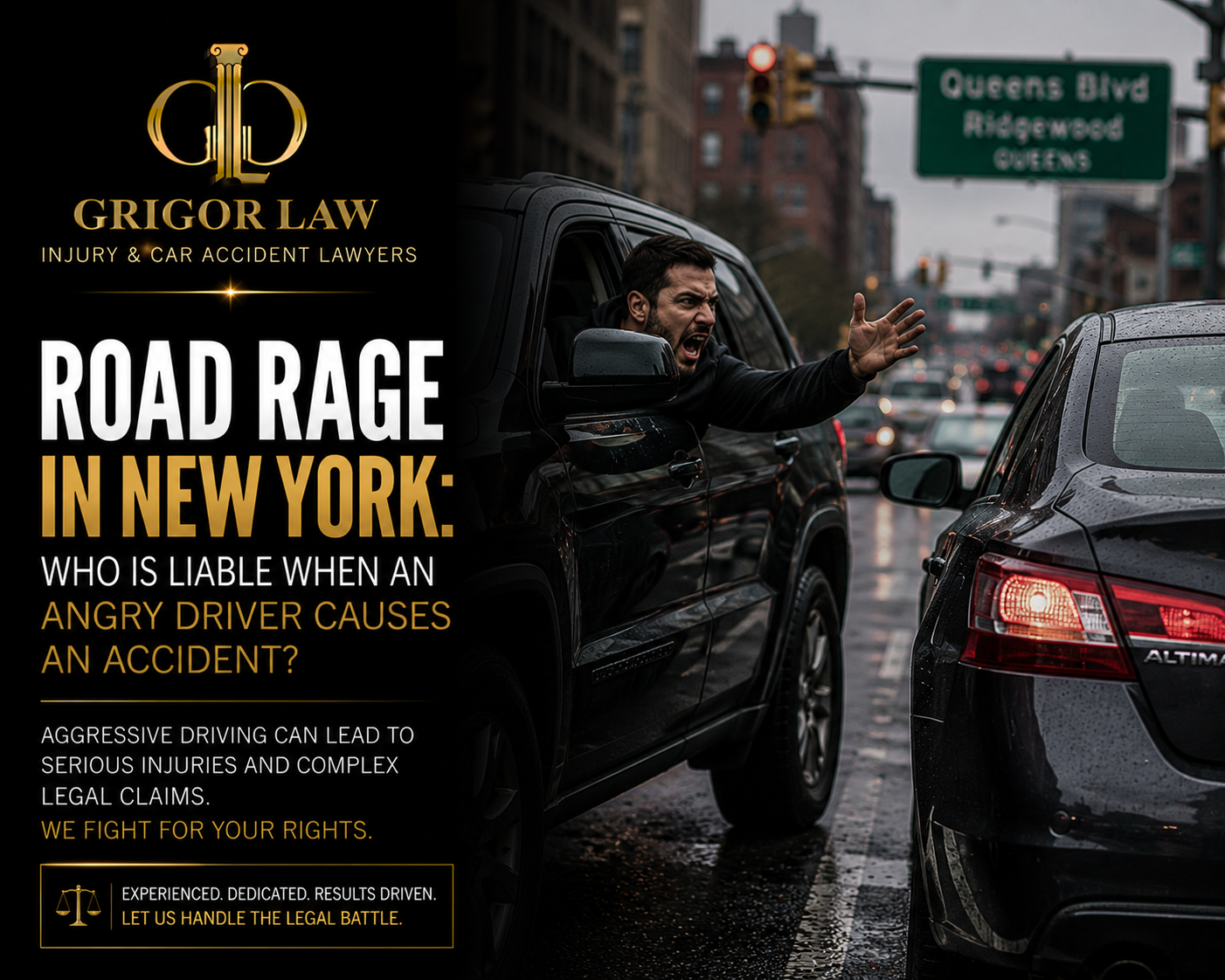
If an angry driver caused your crash, they can be held liable for your injuries. In New York, road rage accident liability falls on the aggressive driver and you can pursue compensation through a civil lawsuit, their insurance, or your own policy’s uninsured motorist coverage.
Road rage cases are more complex than standard car accidents. They involve criminal law, civil liability, insurance exclusions, and strict filing deadlines that can catch victims off guard. This guide breaks down how liability works, what New York’s no-fault law means for your claim, what damages you can recover, and what steps to take to protect your case.
Here is what you need to know.
What Is Road Rage under New York Law?
Road rage is when a driver uses their vehicle or their actions to threaten, intimidate, or harm someone else on the road. It goes beyond bad driving. It’s deliberate aggression.
New York doesn’t have a single law called “road rage,” but the behavior is illegal under several statutes. Depending on what the driver did, they can face criminal charges for reckless driving, menacing, assault, or reckless endangerment.
Common road rage behaviors include:
- Tailgating, brake-checking, or cutting someone off on purpose.
- Forcing another vehicle off the road or blocking their path.
- Threatening another driver with words, gestures, or weapons.
- Using a vehicle as a weapon to ram or chase another car.
Is Road Rage a Crime in New York?
Yes. Even without a specific “road rage” law, an aggressive driver can face serious criminal charges depending on what they did.
- Reckless Driving (VTL § 1212): Driving in a way that unreasonably endangers others. This is a misdemeanor that can result in fines, license points, and jail time.
- Menacing: Intentionally placing someone in reasonable fear of physical injury.
- Reckless Endangerment: Creating a substantial risk of serious physical harm to another person.
- Assault: Causing physical injury to another person. If the driver used their car as a weapon, this can be charged as a felony.
A criminal conviction against the other driver is powerful evidence in your civil injury case. That said, you don’t need a conviction to get compensation civil court uses a lower standard of proof than criminal court.
Who Is Liable for a Road Rage Accident?
The aggressive driver is liable. If their actions whether reckless or intentional caused your injuries, they are legally responsible for your damages.
In a civil personal injury case, you don’t need to prove guilt “beyond a reasonable doubt” the way prosecutors do in criminal court. You only need to show it was more likely than not that the other driver’s aggression caused your injuries. That’s a much easier bar to clear.
If the driver was convicted of a traffic or criminal violation, their fault may be automatically established under a legal principle called negligence per se.
Does New York’s No-Fault Law Apply to Road Rage Crashes?
Yes. New York is ano-fault state. This means your own auto insurance covers your medical bills and a portion of your lost wages after a crash regardless of who caused it. This coverage is called Personal Injury Protection (PIP), and it pays up to $50,000.
To sue the aggressive driver directly for additional compensation, your injuries must meet New York’s serious injury threshold. This is the legal standard that determines when you can step outside the no-fault system and file a lawsuit.
Injuries that qualify include:
- Bone fractures.
- Significant disfigurement.
- Permanent loss of a body organ, member, or function.
- An injury that prevents your normal daily activities for at least 90 of the first 180 days after the crash.
One important deadline: you must file your No-Fault application (Form NF-2) with your own insurance company within 30 days of the accident.
What Damages Can You Recover?
If your injuries meet the serious injury threshold, you can pursue compensation from the at-fault driver for everything the no-fault system doesn’t cover.
| Damage Type | What It Covers |
| Economic Damages | Medical bills, future care, lost wages, lost earning capacity, property damage. |
| Non-Economic Damages | Pain and suffering, emotional distress, PTSD, loss of enjoyment of life. |
| Punitive Damages | Extra compensation meant to punish intentional or malicious conduct. |
Punitive damages are rare, but road rage cases are one of the few situations where New York courts will consider them. To get punitive damages, you need to show the driver acted with malice or a conscious disregard for your safety like deliberately ramming your car or chasing you at high speed.
Will the Other Driver’s Insurance Pay?
Not always. Most auto insurance policies include an intentional act exclusion, which allows the insurer to deny coverage if their policyholder caused the crash on purpose. Insurers argue their policies cover accidents not deliberate criminal behavior.
Here’s the workaround: a skilled attorney can often frame your claim around the driver’s recklessness rather than their intent. Recklessness is typically a covered risk under most policies. This distinction can make the difference between getting paid and getting nothing which is exactly why you shouldn’t handle this on your own.
What If the Driver Fled or Has No Insurance?
You still have options. If the aggressive driver fled the scene or doesn’t have enough insurance to cover your injuries, your own policy likely has protections in place.
- Uninsured/Underinsured Motorist Coverage (UM/SUM): This is required on all New York auto policies. It protects you when the at-fault driver is uninsured, underinsured, or fled the scene. Hit-and-run accidents are treated the same as crashes with uninsured drivers.
- New York State Office of Victim Services (OVS): If the road rage incident qualifies as a violent crime, OVS may help cover medical costs and other expenses.
- A Lawsuit Against the Driver Personally: If the driver has personal assets, you may be able to recover directly from them even without insurance coverage.
What Evidence Do You Need?
Road rage cases are different from typical car accidents because you need to prove the other driver acted aggressively not just carelessly. The stronger your evidence, the stronger your case.
Steps to take immediately after the incident:
- Save dashcam footage right away. Video gets overwritten quickly. Back up your footage the same day.
- Request nearby surveillance footage. Businesses, traffic cameras, and even doorbell cameras may have captured what happened.
- Get witness contact information. Bystanders who saw the aggression can be crucial to your case.
- Obtain the police report. Always call 911 and make sure the officer documents that this was a road rage incident, not just a routine crash.
- Keep a pain journal. Write down your symptoms, limitations, and emotional impact every day. This supports your claim for pain and suffering.
Are You at Fault If You Reacted to the Aggression?
Not necessarily. New York follows pure comparative negligence, which means you can still recover compensation even if you were partly at fault. Your award is simply reduced by your percentage of responsibility.
For example, if a jury finds you 20% responsible and awards you $100,000, you would receive $80,000.
Don’t assume you have no case because you honked back, gestured, or accelerated to get away. The law recognizes that the person who started the aggression typically bears the greater share of fault.
How Long Do You Have to File?
New York law sets strict deadlines called the statute of limitations for filing injury claims. Miss the deadline, and you lose your right to compensation permanently.
- Negligence claim: 3 years from the date of the crash.
- Assault or battery claim: 1 year from the date of the incident.
- Wrongful death claim: 2 years from the date of death.
- No-Fault application: 30 days from the crash date.
- Claim against a government entity: 90 days to file a Notice.
The one-year deadline for assault catches many road rage victims off guard. If the driver intentionally hit you, that clock starts ticking immediately.
What to Do Right After a Road Rage Crash
Stay in your car. If the other driver is still aggressive, keep your doors locked and wait for the police. Never confront an angry driver; your safety comes first.
Call 911 and tell them it’s road rage. This triggers a different police response and ensures the incident is documented correctly from the start.
See a doctor the same day. Adrenaline masks pain. Injuries that feel minor in the moment can turn serious within hours. A gap in medical treatment also gives insurers a reason to question your claim.
Don’t give a recorded statement. Report the crash to your insurance company, but decline to give a recorded statement or sign anything until you’ve spoken to a lawyer. Adjusters are trained to use your words tolimit your payout.
Need Help After a Road Rage Crash?
A road rage crash isn’t just an accident; it’s a violent event with criminal, civil, and insurance layers that require experienced legal guidance. You shouldn’t have to navigate that alone while you’re recovering.
At Grigor Law Injury & Car Accident Lawyers, we represent injured New Yorkers across all five boroughs and Nassau, Suffolk, and Westchester counties. Our firm was founded by Chrissy Grigoropoulos, Esq., a former prosecutor and fierce courtroom advocate recognized as one of the 10 Best Female Attorneys for Client Satisfaction and a Top 40 Under 40 Rising Star.
We’re available 24/7, offer free consultations, and charge nothing unless we win your case. Our team speaks Spanish, Greek, French-Creole, and Korean because no one should face a language barrier when they need legal help most.
Call us at (718) 808-9309 or contact us online to get answers today.
Frequently Asked Questions
Does Insurance Cover Road Rage Damage in New York?
It depends. Insurers may deny coverage for intentional acts, but a lawyer can often reframe the claim around recklessness as a covered risk to preserve your right to compensation. Your own UM/SUM coverage is also available if the other driver’s insurer refuses to pay.
Can I Sue If the Other Driver Intentionally Hit Me?
Yes, but act fast. You can file both a negligence claim and an intentional tort claim for assault or battery. The deadline for intentional tort claims is just one year, much shorter than the three-year negligence deadline.
What If the Other Driver Brake-Checked Me and I Rear-Ended Them?
You may not be at fault. If you can prove the brake check was deliberate and unprovoked, liability can shift to the other driver. Dashcam footage and witness statements are the most effective ways to prove this.
Can I Get Punitive Damages for a Road Rage Crash in New York?
Yes, in serious cases. Punitive damages are available when the driver’s conduct was intentional or malicious, such as deliberately ramming your vehicle or using their car as a weapon. They are not awarded in every road rage case.
What If the Road Rage Driver Fled the Scene?
File a Uninsured Motorist (UM) claim through your own insurance policy. New York law treats hit-and-run drivers the same as uninsured drivers, so you can recover compensation for your injuries even if the other driver is never identified.
How Do Criminal Charges Against the Driver Affect My Civil Case?
A criminal conviction is strong evidence of fault in your civil claim. Even without a conviction, you can still win your injury case; the civil court only requires you to prove the driver’s actions were more likely than not the cause of your injuries.