(718) 249-7447
 Call Us Now


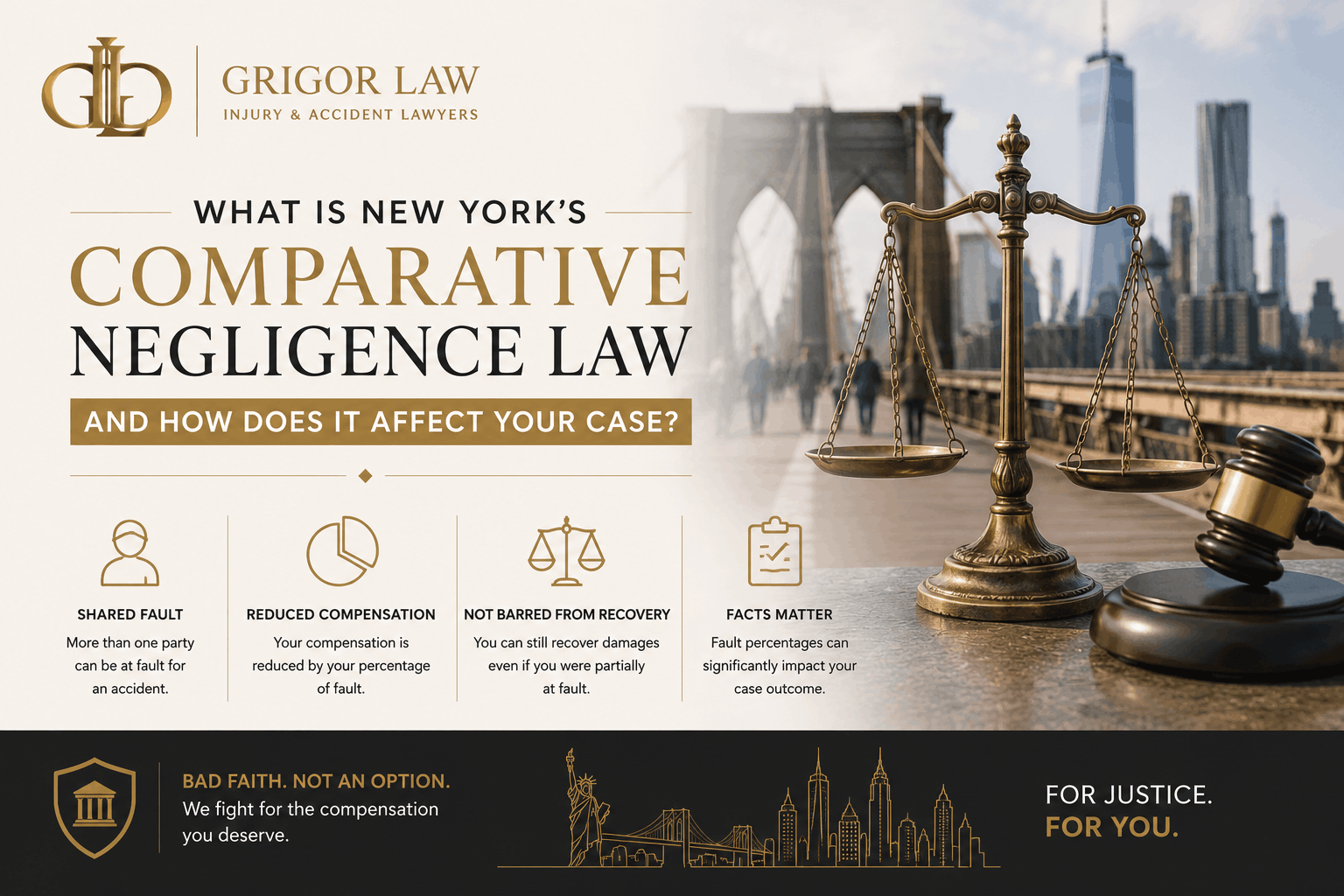
New York’s comparative negligence law allows you to recover compensation for your injuries even if you were partially at fault for the accident. Under this rule, your settlement or verdict gets reduced by your percentage of fault, but you don’t lose your right to compensation entirely. If you’re found to be 30% at fault in a car crash, you can still recover 70% of your total damages.
This law protects injury victims in situations where blame isn’t clear-cut, which happens in most real-world accidents. Unlike many other states that completely bar recovery if you’re 50% or more at fault, New York follows ‘pure’ comparative negligence, meaning you can recover damages even if you were 99% responsible for what happened. Insurance companies know this system and will fight hard to assign as much fault to you as possible to reduce their payout.
This guide explains how New York’s comparative negligence law works, who decides fault percentages, what evidence can protect your claim, and how to fight back when insurance companies try to blame you unfairly.
What Is New York’s Comparative Negligence Law?
Negligence means someone failed to act with reasonable care. When that failure causes your injury, they owe you money for the harm they caused.
This rule applies to almost every type of personal injury case in New York:
- Car accidents and truck crashes.
- Slip and fall incidents.
- Construction site injuries.
- Pedestrian accidents.
- Wrongful death claims.
The law protects you even when things aren’t black and white. Most accidents involve some degree of shared responsibility, and New York recognizes that reality.
Is New York a Pure Comparative Negligence State?
Yes, New York follows pure comparative negligence. This is one of the most victim-friendly systems in the country.
Under pure comparative negligence, you can recover damages regardless of how much fault you bear, even if you were 99% responsible. Many other states cut you off completely if you’re 50% or more at fault.
| Negligence Rule | Can You Recover If Partially at Fault? | Example States |
| Pure Comparative Negligence | Yes, even if 99% at fault | New York, California, |
| Modified Comparative Negligence | Only if less than 50% or 51% at fault | Texas, New Jersey, Pennsylvania, Florida |
| Contributory Negligence | No recovery if even 1% at fault | Alabama, Maryland, Virginia |
This difference matters enormously for your case. In most states, being mostly at fault means you get nothing. In New York, you still have rights.
Even if another lawyer told you your case was hopeless because you shared blame, New York law may still protect your right to compensation.
How Does Comparative Fault Affect Your Settlement or Verdict?
Your percentage of fault directly cuts into the money you receive. The math is straightforward, but insurance companies will fight hard to increase your fault percentage.
Here’s how it works on a $200,000 claim:
- 10% at fault: You recover $180,000.
- 25% at fault: You recover $150,000.
- 50% at fault: You recover $100,000.
Insurance adjusters know this system inside and out. They’re trained to find any reason to blame you, texting while driving, not wearing a seatbelt, or simply not paying enough attention. Their goal is simple: shift as much fault as possible onto you to reduce their payout. They’ll scrutinize every detail of your actions before the accident.
This blame-shifting happens in settlement negotiations and at trial. The other side will hire experts, review traffic cameras, and interview witnesses, all to prove you were more at fault than you actually were.
Who Decides Your Percentage of Fault?
The police officer who responds to your accident doesn’t make the final decision about fault. Neither does the insurance adjuster, despite what they might tell you.
Initially, the other party’s insurance company assigns fault percentages. This is just their starting position and often heavily favors their insured driver.
Your attorney fights this determination by gathering evidence and presenting a different version of events. We negotiate with the insurance company to get a fairer allocation of fault.
If your case goes to trial, a jury makes the final decision. Under New York Civil Practice Law & Rules Section 1412, the defendant must prove you were partially at fault—the burden is on them.
The jury listens to all the evidence and assigns percentages of fault to each party. These percentages must add up to 100%, and whatever the jury decides becomes final.
What Evidence Can Lower Your Percentage of Fault?
Strong evidence is your best weapon against unfair blame. The more proof we gather showing the other party’s negligence, the lower your fault percentage becomes.
Evidence collection starts immediately after your accident. Every day that passes makes it harder to preserve crucial proof that could save you thousands of dollars.
Photos and Video from the Scene
Pictures tell the story better than words ever could. Take photos of vehicle damage, skid marks, traffic signals, and road conditions while you’re still at the scene.
Document your visible injuries right away. Bruises, cuts, and swelling photograph well immediately after an accident but may fade by the time you see a lawyer.
Get wide shots showing the entire accident scene, then close-ups of specific damage. These photos become evidence that insurance companies can’t argue with.
Witness Statements
Independent witnesses carry enormous weight because they have no reason to lie for either side. Their testimony can make or break your case.
Get names and phone numbers before witnesses leave the scene. People are usually willing to help right after an accident, but they become harder to track down later.
Ask witnesses to write down what they saw, or record their statements on your phone. Fresh memories are always more credible than recollections weeks or months later.
Police and Incident Reports
The police report contains key details that shape how insurance companies view your case from day one. A favorable report gives you leverage in negotiations.
While police reports aren’t always admissible in court, they influence settlement discussions. Insurance adjusters rely heavily on the officer’s determination of fault.
If the police report is unfavorable, don’t panic. Officers sometimes get things wrong, especially in complex accidents. Your attorney can challenge inaccurate reports with better evidence.
Surveillance and Dashcam Footage
Video footage is often the most powerful evidence in any accident case. It shows exactly what happened without relying on anyone’s memory or interpretation.
Many businesses have security cameras that might have captured your accident. Traffic cameras and nearby dashcams are also potential sources of footage.
This video is deleted quickly, sometimes within 30 to 60 days. We send preservation letters immediately to prevent crucial evidence from disappearing.
Expert Analysis and Accident Reconstruction
Complex cases often require expert witnesses who can recreate the accident using scientific methods. These experts analyze skid marks, vehicle damage, and impact forces.
Accident reconstruction specialists create computer models showing how the crash happened. They can prove the other driver was speeding, ran a red light, or made an illegal turn.
Medical experts explain how your injuries occurred and why they’re consistent with the accident. This testimony counters insurance company claims that your injuries came from somewhere else.
Does Comparative Negligence Apply to No-Fault and Workers’ Compensation Claims?
This is where many people get confused. Comparative negligence doesn’t apply to every type of claim, only to personal injury lawsuits.
Your no-fault insurance benefits get paid regardless of who caused the accident. These benefits cover up to $50,000 in medical bills and lost wages, and your fault percentage doesn’t reduce them.
Workers’ compensation also ignores fault completely. If you’re injured on the job, you get benefits whether the accident was your fault, your employer’s fault, or nobody’s fault.
Comparative negligence only comes into play when you file a lawsuit for additional damages:
- Pain and suffering compensation.
- Lost wages beyond what no-fault covers.
- Future medical expenses.
- Property damage to your vehicle.
There’s one important exception: third-party workplace claims. If someone other than your employer or coworker causes your work injury, comparative negligence applies to your lawsuit against that party.
For example, if you’re a construction worker injured by a negligent driver, your workers’ compensation claim isn’t affected by fault, but your lawsuit against the driver is subject to comparative negligence.
Can You Still Recover if You Are Mostly at Fault?
Yes, and this is what makes New York’s law so powerful for injury victims. Even if you’re 90% responsible for the accident, you can still recover 10% of your damages.
If you were speeding when another driver ran a red light and struck your vehicle, the other driver still violated traffic laws, and a jury might find you 75% at fault for speeding and the other driver 25% at fault for running the red light. You’d still recover 25% of your total damages.
However, there’s a flip side to consider. If you’re found partially at fault, the other party might file a counterclaim against you for their injuries and property damage.
This is why having an experienced attorney matters from day one. We protect you from counterclaims while fighting to minimize your percentage of fault.
What Steps Should You Take to Protect Your Claim?
What you do immediately after an accident directly impacts your ability to recover fair compensation. Smart actions in the first few hours and days can save your case.
Insurance companies start building their defense against you immediately. They send investigators to the scene, interview witnesses, and look for ways to blame you.
Get Medical Care and Follow Your Treatment Plan
See a doctor immediately, even if you feel fine. Some injuries like concussions and soft tissue damage don’t show symptoms right away.
Follow your doctor’s orders exactly. Missed appointments and gaps in treatment give insurance companies ammunition to argue your injuries aren’t serious.
Keep all medical records and bills organized. These documents prove the extent of your injuries and the cost of your treatment.
Document the Scene and Your Injuries
Use your phone to photograph everything you can while you’re still at the accident scene. Get pictures of all vehicles involved, street signs, and traffic lights.
Take photos of your injuries immediately and throughout your recovery. Document how your injuries affect your daily life—struggling to get dressed, using crutches, or wearing a neck brace.
Write down everything you remember about the accident while it’s fresh in your mind. Include details like weather conditions, what you were doing before the crash, and what the other driver said.
Avoid Admissions and Recorded Statements
Never apologize or admit fault at the scene, even if you think you might have done something wrong. Apologies can be twisted into admissions of guilt later.
The other driver’s insurance company will call asking for a recorded statement. Politely decline and tell them to contact your attorney.
Insurance adjusters are trained to ask leading questions that make you sound more at fault than you actually are. Anything you say gets used against you later.
Preserve Evidence and Keep Every Record
Start a file with all documents related to your accident. Include medical bills, pay stubs showing lost income, and vehicle repair estimates.
Save every letter and email from insurance companies. Keep a journal documenting your pain levels, missed work days, and how your injuries affect your life.
Don’t post about your accident on social media. Insurance companies monitor your accounts looking for posts that contradict your injury claims.
Call a New York Personal Injury Lawyer Before Talking to Insurers
Contact an attorney before giving any statements to insurance companies. We handle all communications with insurers and protect you from their tactics.
Most personal injury lawyers work on contingency, meaning you pay nothing unless we win your case. There’s no risk in getting legal advice early.
An experienced attorney starts building your case immediately while evidence is still fresh and witnesses are available.
Why Choose Grigor Law Injury & Car Accident Lawyers to Fight Comparative Negligence Tactics?
Insurance companies have teams of lawyers whose only job is paying you as little as possible. You need a fierce advocate who knows their playbook inside and out.
Chrissy Grigoropoulos founded Grigor Law after years of courtroom experience that taught her how insurance companies really operate. She’s been recognized as a Top 40 Under 40 Rising Star and one of the 10 Best Female Attorneys for Client Satisfaction.
Our firm has built a reputation for aggressive advocacy in courts across all five boroughs of New York City, plus Nassau, Suffolk, and West chester counties. We know the judges, we know the opposing lawyers, and we know how to win.
We conduct thorough investigations to gather evidence that fights back against blame-shifting tactics. Our team includes investigators, medical experts, and accident reconstruction specialists who build bulletproof cases.
Grigor Law serves New York’s diverse communities with attorneys and staff who speak Spanish, Greek, French-Creole, and Korean. We’re available 24/7 because legal emergencies don’t wait for business hours.
We work on contingency, so you pay nothing unless we win your case. If an insurance company is trying to blame you for an accident that wasn’t entirely your fault, we’re ready to fight back with everything we’ve got.
Injured in New York? Talk to a Personal Injury Lawyer Today
Time works against you after an accident. Physical evidence disappears, witnesses forget details, and surveillance footage gets deleted automatically.
Insurance companies know this, which is why they move fast to lock in their version of events. You need legal representation that moves even faster.
New York’s statute of limitations gives you three years to file most personal injury lawsuits, but waiting that long can destroy your case. The best evidence is available immediately after your accident.
Call Grigor Law now for a free consultation. We’ll evaluate your case, explain your rights under New York’s comparative negligence law, and start building your claim right away.
You pay no attorney fees unless we win your case. We’re available 24/7 to answer your questions and fight for the compensation you deserve.
New York Comparative Negligence FAQs
Can You Recover Damages if You Were 70% at Fault in New York?
Yes, you can still recover 30% of your total damages under New York’s pure comparative negligence rule. Even being mostly at fault doesn’t eliminate your right to compensation.
What Is the 50% Rule and Does It Apply in New York?
The 50% rule bars recovery if you’re more than 50% at fault, but New York doesn’t use this rule. New York follows pure comparative negligence with no cutoff percentage.
Does Comparative Negligence Reduce Your No-Fault Benefits?
No, your no-fault insurance benefits are paid regardless of fault. Comparative negligence only affects personal injury lawsuits, not your PIP coverage for medical bills and lost wages.
What Are the Four Elements Needed to Prove Negligence in New York?
You must prove duty of care, breach of that duty, causation, and damages. All four elements are required to win a personal injury case in New York.
How Long Do You Have to File a Personal Injury Lawsuit in New York?
You generally have three years from the accident date, but wrongful death cases have a two-year deadline. Claims against government entities require notice within 90 days.
Should You Give the Insurance Company a Recorded Statement?
Never give a recorded statement without speaking to your attorney first. Insurance adjusters use these statements to assign more fault and reduce your compensation.