
 (718) 249-7447
 Call Us Now


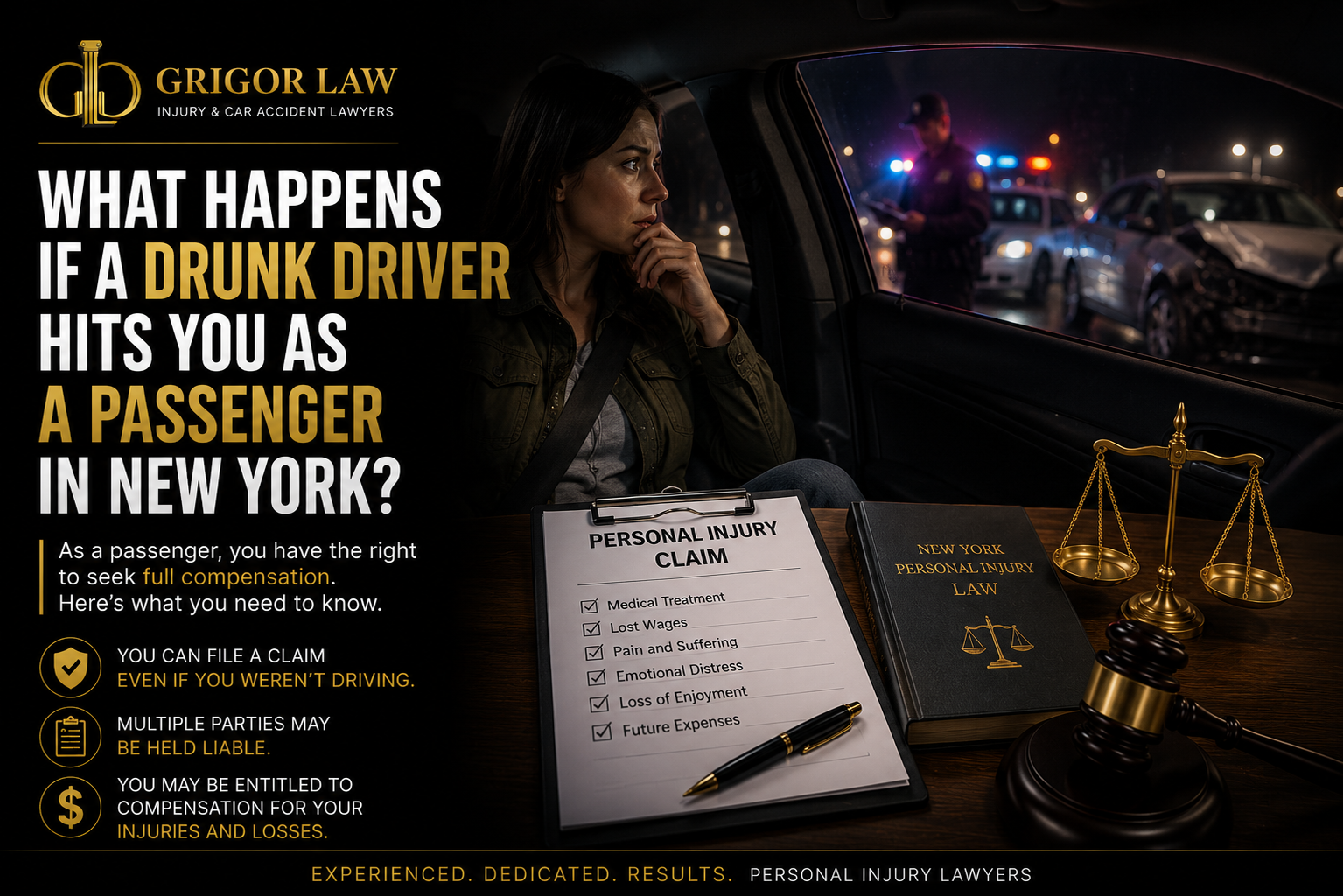
If a drunk driver hit you as a passenger in New York, you have the right to file a claim and recover compensation, even if you were riding with the drunk driver. Passengers are almost always treated as innocent parties under New York law, which puts you in a strong legal position from the start.
This article covers everything you need to know: how New York’s no-fault insurance pays your medical bills first, when you can sue for pain and suffering, who can be held liable, and what your compensation could include.
Here is exactly what your rights are and how to protect them.
Can You File a Claim as a Passenger in a New York Drunk Driving Crash?
Yes, and your position is actually stronger than most people realize. As a passenger, you are almost always considered an innocent party, which means fault rarely falls on you.
You can file a no-fault claim for immediate medical expenses and lost wages, and you can also pursue a personal injury lawsuit against every party responsible for the crash. Depending on what happened, that could include the drunk driver, the vehicle owner, another driver, or even the bar that served them.
Who Pays Your Medical Bills First?
New York is a no-fault state. This means that no matter who caused the crash, the insurance on the vehicle you were riding in pays your medical bills and lost wages first, no proof of fault required.
This coverage is called Personal Injury Protection, or PIP. Here’s what it covers:
· Medical expenses: Up to $50,000 for ER visits, surgery, rehab, and prescriptions.
· Lost wages: Up to 80% of your income, capped at $2,000 per month for up to three years.
· Transportation costs: Up to $25 per day for trips to medical appointments.
· Death benefit: A $2,000 payment to the estate if the crash is fatal.
You have only 30 days to file to submit your no-fault application after the crash. Miss that deadline and you could lose these benefits entirely. PIP is your starting point, but it is not your only option.
When Can You Sue for Pain and Suffering?
To file a lawsuit for pain and suffering, your injuries must meet what New York calls the serious injury threshold. This is a legal standard that determines whether your injuries are severe enough to step outside the no-fault system and pursue a full lawsuit.
You qualify if you suffered:
· A bone fracture (any broken bone counts).
· Significant disfigurement, such as visible permanent scarring.
· Permanent loss of use of a body organ, member, or system.
· Significant limitation of a body function or system.
· An injury that prevented your normal daily activities for 90 out of 180 days after the crash.
· Death.
Drunk driving crashes are high-speed, high-force collisions. They frequently produce the kind of serious injuries that qualify. Once you cross this threshold, the next question is who you can hold accountable.
Who Can You Hold Liable After a Drunk Driving Crash?
As a passenger, you can often pursue more defendants than a driver could. This matters because a drunk driver might only carry minimum auto insurance, in New York, that can be as low as $25,000, which rarely covers serious injuries.
Here is who can be held responsible:
· The drunk driver: Driving while intoxicated is illegal. That law violation is itself proof of negligence, which lawyers call negligence per se.
· The vehicle owner: Under New York law, a vehicle owner is responsible for how their car is used , even if someone else was driving with their permission.
· Another driver: If a second driver contributed to the crash through speeding or distracted driving, they share liability too.
· An employer: If the drunk driver was working at the time , driving for a rideshare company or making deliveries, their employer may also be liable.
· A bar or restaurant: If they served the driver alcohol when he or she was already visibly drunk, they can be sued under the Dram Shop Act.
Can You Sue the Bar That Overserved the Drunk Driver?
Yes. Under New York’s Dram Shop Act, any bar, restaurant, or liquor store that served alcohol to a visibly intoxicated person, or to anyone under 21, can be held legally responsible for the harm that person later causes.
“Visibly intoxicated” means showing obvious signs of being drunk: slurred speech, stumbling, glassy eyes, or loud and aggressive behavior.
This law is especially important for passengers. Commercial liquor liability policies often provide $1 million or more in coverage, which can make a real difference when a drunk driver’s auto policy falls short. In some cases, you may also recover punitive damages, extra money the court awards specifically to punish reckless behavior.
Bar surveillance footage is typically deleted within 24 to 72 hours. Acting fast is critical. At Grigor Law, we send legal preservation letters within hours of being retained to protect that evidence before it disappears.
What If You Were Riding with the Drunk Driver?
You can still recover compensation, even if you knew the driver had been drinking. New York follows a rule called pure comparative negligence. This means your compensation is reduced by your percentage of fault, but you are never completely barred from recovering.
Here is a simple example: if a jury finds you 20% responsible for getting in the car with someone who was drunk, and your total damages are $500,000, you would still recover $400,000.
One concern we hear often is: “I don’t want to hurt my friend.” It is important to understand that filing a claim is not a personal attack. In almost every case, the claim is made against the driver’s auto insurance policy, not their personal savings. That is exactly what insurance is there for. We handle these conversations with care and confidentiality every step of the way.
Does the Criminal DWI Case Affect Your Injury Claim?
No, and you do not need to wait for it to finish. The criminal case and your civil injury claim are two completely separate legal proceedings.
· The criminal case: Brought by the District Attorney to punish the driver. The standard of proof is “beyond a reasonable doubt,” which is very high.
· Your civil case: Brought by you to recover money for your losses. The standard of proof is simply “more likely than not,” which is a much lower bar.
A DWI conviction can strengthen your civil case, but even if charges are reduced or dismissed, you can still win your lawsuit. We move forward on your civil claim immediately and coordinate with prosecutors when it helps your case.
What Compensation Can You Recover?
Passengers in drunk driving crashes can recover both economic and non-economic damages. Economic damages cover your real, measurable losses. Non-economic damages cover the personal toll the crash has taken on your life.
| Type of Compensation | What It Covers |
| No-fault PIP benefits | Medical bills up to $50,000, lost wages, and basic expenses , no fault required. |
| Economic damages | Medical costs beyond PIP, future care, full lost wages, and lost earning capacity. |
| Non-economic damages | Pain and suffering, emotional distress, and loss of enjoyment of life. |
| Loss of consortium | Your spouse’s loss of companionship and intimacy. |
| Punitive damages | Extra damages to punish drunk drivers or bars for reckless conduct. |
| Wrongful death damages | Funeral costs, lost financial support, and loss of guidance for surviving families. |
If the drunk driver had no insurance or fled the scene, you are not out of options. Your own Uninsured/Underinsured Motorist coverage, known as UM/SUM, can step in. If no insurance is available at all, the Motor Vehicle Accident Indemnification Corporation (MVAIC) exists specifically to protect victims in exactly this situation.
How Long Do You Have to File?
New York has strict legal deadlines, and missing them can permanently end your right to compensation.
· You have 30 days to file your no-fault application after the crash.
· You have 90 days to file a Notice of Claim if a government vehicle was involved.
· You have 2 years to file a wrongful death lawsuit.
· You have 3 years from the crash date to file a personal injury lawsuit.
Many passenger injury claims are resolved relatively quickly, though more serious or complicated cases often take longer. Cases involving severe injuries or multiple defendants can take longer. We work quickly to build your case while making sure you are never pushed into accepting a settlement that does not fully cover your needs.
Injured as a Passenger by a Drunk Driver? We Are Here 24/7
A drunk driving crash can turn your life upside down in seconds. You should not have to face insurance companies, legal deadlines, and recovery all at once.
At Grigor Law Injury & Car Accident Lawyers, founded by Chrissy Grigoropoulos, Esq., we represent and advocate for injured New Yorkers. Chrissy has been recognized as a Top 40 Under 40 Rising Star and one of the American Institute of Personal Injury Attorneys’ 10 Best Female Attorneys for Client Satisfaction, because results and client care are never separate priorities here.
We offer free consultations 24/7 in English, Spanish, Greek, French-Creole, and Korean. You pay nothing unless we win your case. Call (718) 808-9309 to speak with our team today.
Frequently Asked Questions
Can a Passenger Sue Both Drivers in a Two-Car Drunk Driving Crash?
Yes, if a sober driver also contributed to the crash, you can pursue claims against both drivers’ insurance policies. Pursuing every responsible party is often essential to fully cover serious injuries.
What If You Were Also Drinking? Can You Still Recover?
Yes. Your own intoxication does not cause a crash; the driver’s choice to drive drunk does. Your drinking generally has no effect on your right to file a passenger injury claim.
Do You Get No-Fault Benefits If You Do Not Own a Car?
Yes. No-fault coverage follows the vehicle, not the driver or the passenger. Even without your own auto insurance, you are covered by the policy on the car you were riding in.
What If the Drunk Driver Was Uninsured or Fled the Scene?
You can still recover through your own UM/SUM coverage, the policy on the vehicle you were in, or through MVAIC if no other insurance is available. We investigate every crash to find every possible source of recovery.
How Quickly Do You Need to Act to Preserve Bar Surveillance Footage?
Act quickly to preserve bar surveillance footage, as recordings are often kept on short loops that can be overwritten. Contacting an attorney immediately allows us to send a legal preservation notice before that evidence is gone for good.


