
 (718) 249-7447
 Call Us Now


Water can turn dangerous faster than most parents realize. One moment of inadequate supervision at a community pool, a missing fence around an apartment complex swimming area, or defective safety equipment at a public beach can lead to catastrophic injuries or death.
For families across Ridgewood and Queens, these preventable incidents leave behind medical bills, ongoing care needs, and questions about who bears responsibility.
Drowning cases demand immediate legal action. Unlike typical injury claims, critical evidence in water-related accidents often vanishes within hours. Surveillance footage gets overwritten, witnesses leave without providing statements, and property owners quickly repair hazards to avoid liability.
The law also treats these cases differently, imposing specific safety regulations for pools, heightened duties for properties that attract children, and strict government claims deadlines that can expire in just 90 days.
At Grigor Law Injury & Car Accident Lawyers, we know the specific laws governing pools, beaches, and waterways throughout New York. We move fast to preserve evidence, identify all liable parties, from property owners to lifeguard companies, and build cases that account for both immediate medical needs and long-term care requirements.
Our Ridgewood office serves families in their preferred language, whether that’s English, Spanish, Greek, French Creole, or Korean, and we’re available around the clock because emergencies don’t wait for office hours.
You won’t pay anything unless we secure compensation for your family. We handle every aspect of your case while you focus on healing and supporting your loved ones through recovery.
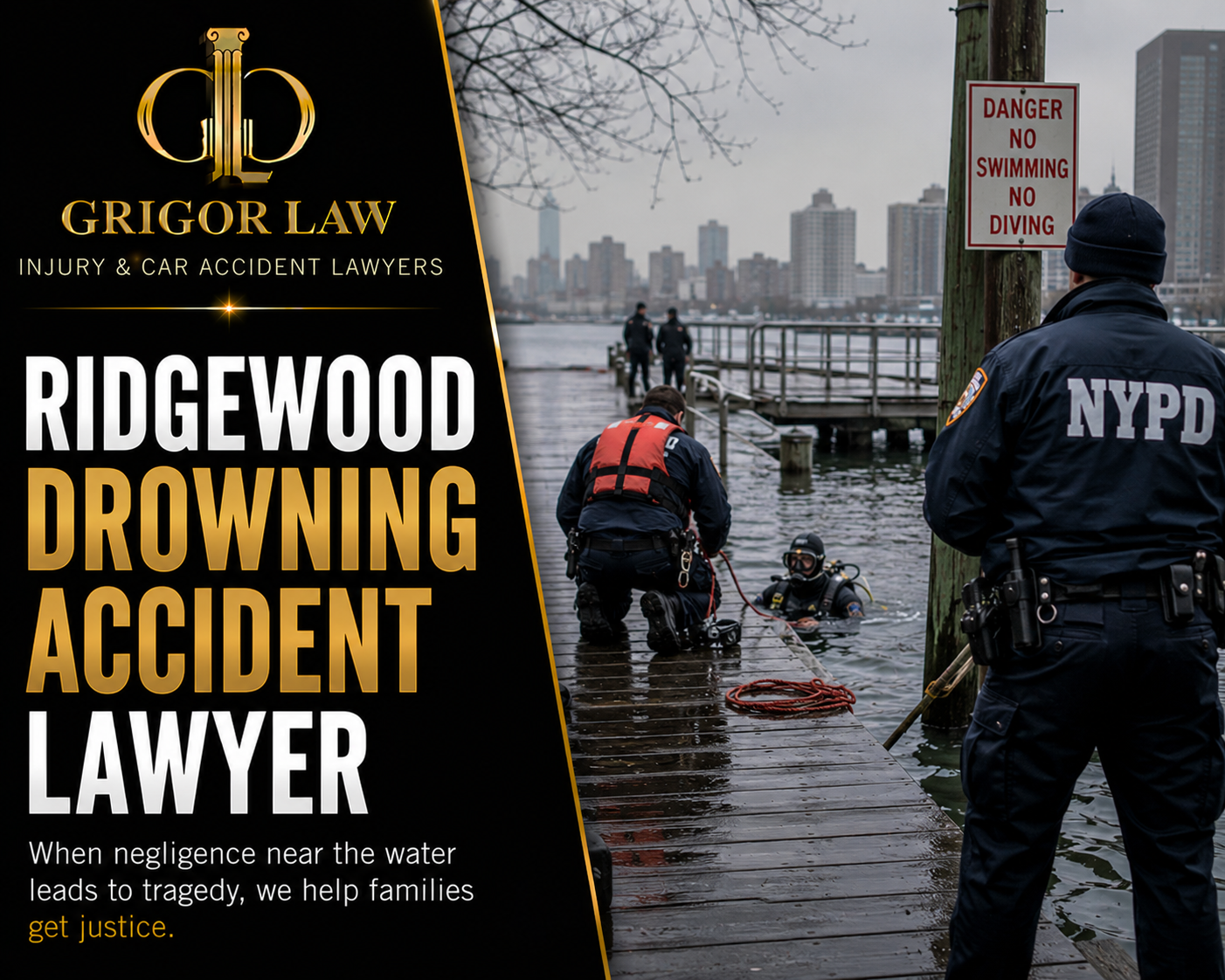
Suffered a Drowning Accident in Ridgewood? We Fight for Your Family
A drowning or near-drowning changes everything in seconds. If someone’s negligence caused your family’s tragedy, you have the right to hold them accountable. At Grigor Law Injury & Car Accident Lawyers, our Ridgewood drowning accident lawyers are available 24/7 to investigate what happened, lock down evidence before it disappears, and fight for full compensation on your behalf.
Consultations are always free, and you pay nothing unless we win. Our team serves Ridgewood and all of Queens in Spanish, Greek, French Creole, and Korean because a language barrier should never stand between your family and justice.
Call (718) 249-7447 or contact us online to speak with a Ridgewood drowning accident attorney today.
Where Drowning Accidents Happen in Ridgewood and Queens
Drowning incidents happen in more places than most people expect. Each location comes with its own set of safety rules and its own set of parties who can be held responsible when those rules are ignored.
- Apartment and hotel pools: Landlords and property managers are legally required to maintain working fences, self-latching gates, visible depth markers, and drain covers that comply with the Virginia Graeme Baker Pool and Spa Safety Act. When those standards are ignored, a drowning becomes a legal matter.
- NYC Parks pools and public beaches: City-run facilities like Rockaway Beach or local Queens pools must provide trained lifeguards and post clear warnings about hazardous conditions. When they fail, the City of New York may be liable, but strict filing deadlines apply.
- Daycares, camps, and schools: Any organization responsible for supervising children near water owes them a heightened duty of care. A moment of inattention during a swim lesson or field trip can have permanent consequences.
- Boating and open water: Capsizing, falls overboard, and propeller injuries can all result in drowning. These cases may involve state law, federal maritime law, or both, depending on the waterway.
Who Is Liable for a Drowning Accident in New York?
Liability in a drowning case is rarely limited to one person. Under New York premises liability law, any party that controlled the property or supervised the victim may share responsibility for what happened.
Property owners have a legal duty to maintain reasonably safe conditions. For children, that duty is even higher. Pools are considered an “attractive nuisance,” meaning a feature likely to draw in children who don’t fully understand the danger.
If an owner knew children could access the pool and failed to secure it, that alone can establish negligence.
Potentially liable parties include:
- Property owners, landlords, and building managers.
- The City of New York and its agencies, including NYC Parks.
- Hotels, gyms, country clubs, and homeowners’ associations.
- Daycares, summer camps, swim instructors, and schools.
- Third-party lifeguard staffing companies.
- Manufacturers of defective pool drains, gates, or safety equipment.
- Boat operators, rental companies, and marinas.
Common Causes of Drowning Accidents
Most drowning accidents are preventable. They happen not because of bad luck, but because someone failed to do their job.
- Distracted, absent, or undertrained lifeguards.
- Broken or unlocked pool fencing and self-closing gates.
- Defective drain covers that create dangerous suction.
- Missing or inadequate “no diving” signs and depth markers.
- Alcohol served to boat operators or pool guests.
- Rescue equipment ring buoys, shepherd’s crooks, AEDs that was missing or broken.
- Pools operating beyond safe capacity limits.
What to Do After a Drowning or Near-Drowning in NYC
The decisions made in the first 48 hours after a drowning can shape the entire legal case. Here is what to do and what to avoid.
Get medical care immediately. Even when a person appears fine after being pulled from the water, they need to be evaluated for secondary drowning and delayed anoxic brain injury conditions that can appear hours later. Medical records also serve as the foundation of any injury claim.
Report the incident in writing. Notify the property owner, facility manager, or responsible agency and demand a written incident report. Keep a copy before you leave.
Document everything you can. Photograph the pool area, fencing, signage, drain covers, and any visible hazards. Collect names and phone numbers from anyone who witnessed the incident. Witnesses are often the first thing to disappear.
Do not give a recorded statement. Insurance adjusters may call quickly and sound sympathetic. They are not. Politely decline to provide any recorded statement until you have spoken with an attorney.
Call a Ridgewood drowning accident lawyer right away. The sooner we are involved, the more evidence we can preserve. We send legal notices to property owners immediately to prevent the destruction of surveillance footage, maintenance logs, and inspection records.
What Compensation Can Your Family Recover?
No settlement can undo what your family has been through. But fair compensation provides financial stability and holds the responsible parties accountable for their choices.
In New York, drowning victims and their families can pursue both economic and non-economic damages. In fatal cases, the family may bring a wrongful death claim under New York’s Estates, Powers & Trusts Law (EPTL) a legal framework that allows surviving family members to recover for their financial losses.
| Damage Type | What It Covers |
| Medical Expenses | Emergency care, hospitalization, neurological rehabilitation, and ongoing therapy |
| Lost Income | Wages lost during recovery and reduced future earning capacity |
| Pain and Suffering | Physical pain, emotional trauma, and loss of enjoyment of life |
| Wrongful Death | Funeral costs, pre-death medical bills, and financial losses to surviving family |
| Catastrophic Care | Lifetime medical care for survivors with permanent brain injuries |
For near-drowning survivors left with anoxic brain damage, a condition caused by oxygen deprivation to the brain, we work with medical and life-care planning experts to calculate the true long-term cost of care.
How Long Do You Have to File a Drowning Claim in New York?
New York law sets firm deadlines for filing drowning accident claims. Missing them means permanently losing your right to compensation.
- Personal injury claims: 3 years from the date of the incident.
- Wrongful death claims: 2 years from the date of death.
- Claims against NYC or a municipal agency: A Notice of Claim must be filed within 90 days of the incident. The lawsuit itself must follow within 1 year and 90 days.
- Federal maritime claims: Generally, 3 years, but the rules vary depending on the waterway and the parties involved.
The 90-day window for municipal claims is the one most families miss. If the drowning happened at a city pool, a public beach, or a school, contact us immediately.
Can You Still File a Claim If Your Loved One Was Partly at Fault?
Yes. New York follows a rule called pure comparative negligence, which means your family can still recover compensation even if your loved one was found partially responsible for what happened. The total award is simply reduced by their percentage of fault.
For example, if a teenager ignored a posted “no swimming” sign but the property owner also failed to install a required fence, a court might find the teenager 20% at fault. Your family could still recover 80% of the total damages.
Insurance companies routinely try to shift blame onto the victim to reduce what they pay. We push back on that hard.
Are Liability Waivers Enforceable in New York?
Many families assume that a waiver signed at a gym, camp, or pool facility ends their case before it starts. In most situations, that is not true.
Under New York General Obligations Law § 5-326, liability waivers signed at recreational facilities that charge a fee are generally unenforceable for negligence claims. Even if a waiver is technically valid, it cannot protect a property owner from liability for gross negligence or intentional misconduct.
Do not walk away from a case because of a form you signed. Let us review it.
Which Law Applies New York State or Federal Maritime Law?
The answer depends on where the drowning occurred. Incidents at pools, private lakes, and ponds are governed by New York personal injury and premises liability law. Drownings that happen on navigable waterways such as the East River, Jamaica Bay, or the Atlantic Ocean may fall under federal maritime law, which has different rules for damages, deadlines, and liability.
Some cases involve both legal frameworks. Our team evaluates every angle to pursue the strongest possible claim for your family.
Why Ridgewood Families Choose Grigor Law
Chrissy Grigoropoulos, Esq., founded Grigor Law with a clear purpose: to give injury victims in Queens and across New York a legal team that fights as hard for them as the insurance companies fight against them. She has been recognized as a Top 40 Under 40 Rising Star and one of the American Institute of Personal Injury Attorneys’ 10 Best Female Attorneys for Client Satisfaction.
Our Brooklyn/Queens office is located at 6088 Myrtle Ave in Ridgewood not a distant firm taking cases from a call center, but a team rooted in the same neighborhood you live in.
- Available 24/7: We answer calls at night, on weekends, and on holidays.
- Multilingual service: Spanish, Greek, French-Creole, and Korean.
- No upfront costs: All drowning and wrongful death cases are handled on contingency you pay nothing unless we recover compensation for you.
- Rapid response: We move fast to preserve evidence, retain experts, and protect your family’s legal rights from day one.
Contact Grigor Law Injury & Car Accident Lawyers today for a free, confidential consultation. Call (718) 249-7447. We are here for your family, day or night. Hablamos español. Μιλάμε ελληνικά. Nou pale kreyòl. 우리는 한국어를 구사합니다.
Frequently Asked Questions
Who Can File a Wrongful Death Claim in New York After a Drowning?
Only the personal representative of the deceased person’s estate may file a wrongful death claim in New York. That claim is brought on behalf of surviving family members, such as a spouse, children, or parents, to recover for their financial losses.
What Happens If the Drowning Occurred at an NYC Parks Pool or Public Beach?
Claims against the City of New York require a Notice of Claim filed within 90 days of the incident. Missing this deadline can permanently bar your family from recovering compensation, which is why contacting an attorney immediately is so important.
Can a Family Sue If No Lifeguard Was on Duty?
Yes. The absence of a required lifeguard is one of the clearest forms of negligence in a drowning case. If a facility was legally required to staff a lifeguard and failed to do so, that failure can be the foundation of a strong premises liability claim.
How Are Near-Drowning Brain Injury Cases Different from Fatal Drowning Cases?
Near-drowning cases involving anoxic brain damage are handled as catastrophic injury claims because survivors often require lifelong medical care and support. We work with neurologists and life-care planning experts to calculate the full cost of future treatment and ensure that compensation reflects the true scope of your loved one’s needs.
Does It Cost Anything to Hire a Ridgewood Drowning Accident Lawyer?
No. Grigor Law handles all drowning and wrongful death cases on a contingency fee basis, meaning there are no upfront costs and no attorney fees unless we win compensation for your family.