(718) 249-7447
 Call Us Now


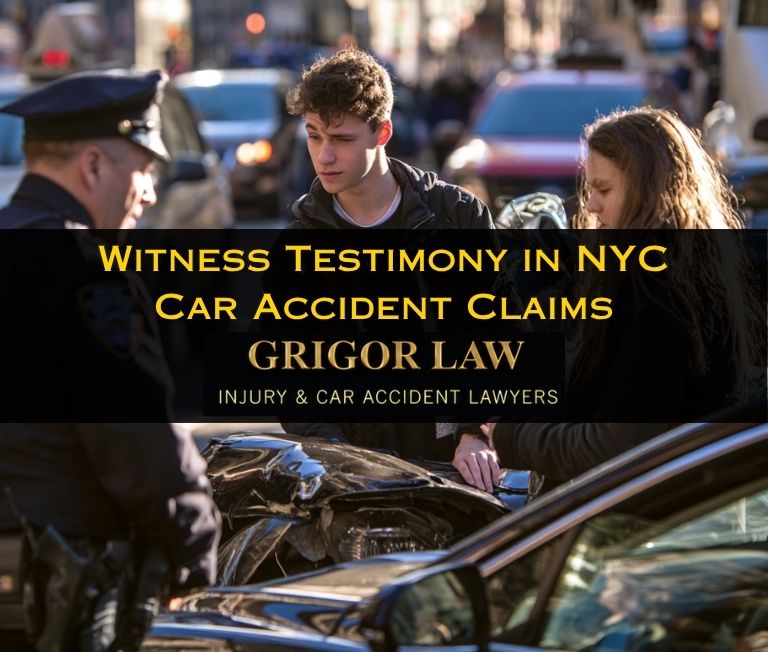
Witness testimony is one of the most important pieces of evidence in a New York City car accident claim. New York City accidents often come down to disputed facts. Drivers deny fault, and insurance adjusters are trained to find any reason to minimize what they owe.
A credible, independent witness confirms who caused the crash when drivers and insurers cannot agree.
In this article, you will discover who qualifies as a witness, how to find and preserve statements after a crash, what makes a witness credible, and how our skilled injury attorneys use witness testimony to build your claim.
Why Witnesses Matter in Your NYC Car Accident Claim
Your word against the other driver’s word is not enough. Insurance companies exploit that gap, and without a third-party account confirming what happened, they will push to pay you as little as possible.
A witness is someone who saw the crash and has no stake in the outcome. Their account cuts through the “he said, she said” dispute that insurers use to deny and delay your claim.
What Is a Car Accident Witness Statement?
A witness statement is a formal account from someone who observed the crash but was not driving or riding in any of the vehicles involved. It documents what they saw, heard, and experienced at the scene.
These statements come in different forms depending on where your case stands:
- Informal statement: A phone recording or notes captured at the scene right after the crash.
- Sworn affidavit: A signed, notarized document used during settlement negotiations with the insurance company.
- Deposition testimony: Recorded answers given under oath before trial during the legal process.
- Trial testimony: Live courtroom testimony where the witness is questioned by both sides.
Who Can Be a Witness in New York City?
Anyone with firsthand knowledge of the crash can serve as a witness in your claim. Credibility matters just as much as what they actually saw.
Eyewitnesses at the Scene
The strongest witnesses are people who watched the crash happen and have no connection to either driver. New York City sidewalks are almost always crowded, so pedestrians, doormen, delivery workers, taxi drivers, MTA bus operators, and nearby storefront employees all qualify.
Passengers as Witnesses
A passenger in your car can testify about what they observed, and their account can absolutely help your case. Insurance companies will argue they are biased in your favor, so their testimony carries the most weight when it matches what an independent bystander saw.
Expert and Police Witnesses
The responding NYPD officer documented the scene and can testify about what they observed. Expert witnesses, like accident reconstructionists, analyze physical evidence to explain how the crash happened, they do not need to have been present to testify.
What Makes a Witness Credible in New York?
Credibility determines how much weight a witness carries with a jury or an insurance adjuster. Key factors include:
- Independence: They have no connection to you or the other driver and nothing to gain from the outcome.
- Vantage point: They had a clear, unobstructed view of the crash from start to finish.
- Consistency: Their account aligns with the physical evidence and does not change over time.
- Condition: They were sober and alert when the crash occurred.
- Demeanor: They present their account calmly and without exaggeration.
We lock down a documented record of each witness from the very first hour, before insurers have a chance to undermine their account.
How to Find Witnesses After a NYC Crash
Witnesses scatter fast in New York City. The first minutes after a crash are your best window to gather contact information before people walk away.
If you are physically able, approach nearby bystanders, ask what they saw, and collect their name, phone number, and email. Record a quick video statement on your phone.
If you were too injured to gather names, we take over immediately. Our team canvasses the crash site, subpoenas traffic and business surveillance footage, pulls 911 audio through public records requests, and posts witness-sought notices near the scene to track down anyone who can support your claim.
How to Preserve Witness Testimony
Memory fades quickly. Statements should be secured within 24 to 72 hours, before recollections fade and outside conversations begin to alter what a witness believes they saw.
At the scene: Record the witness describing the vehicles, traffic signal colors, direction of travel, and anything either driver said after the crash.
Within 72 hours: Our investigators reinterview witnesses and secure formal, signed statements. Video accounts are especially powerful, they capture tone and confidence, details that matter to adjusters and juries alike.
If you are hospitalized or homebound: We come to you. Our attorneys travel to hospitals, rehab centers, and homes across all five boroughs and Long Island. We have offices in Ridgewood (serving Brooklyn and Queens), the Bronx, and Hempstead.
A pattern our personal injury attorneys in Queens see often when a witness statement sits uncollected for even a few days is small details starting to shift, a traffic light color, the order two cars moved, in ways that give the defense something to attack at trial. We send an investigator to reinterview and lock in a signed statement within 72 hours whenever we can.
What a Strong Witness Statement Should Include
A useful statement captures specific, objective facts, not general impressions. Vague accounts are easy for insurance companies to dismiss.
| Category | Details to Document |
| Contact Information | Full name, phone number, email, and employer |
| Crash Details | Exact time, date, and intersection |
| Scene Conditions | Weather, lighting, and road surface |
| Vehicle Behavior | Direction of travel, speed, and lane changes |
| Traffic Signals | Signal colors for all directions |
| Driver Actions | Erratic driving, phone use, or sudden braking |
| Post-Crash Events | Anything said by either driver at the scene |
| Visible Injuries | What the witness observed about your condition |
| Personal Evidence | Whether the witness took photos or video |
Locking in these details early is what separates testimony the defense cannot touch from one they can dismantle.
Do Witnesses Help You Step Outside New York’s No-Fault System?
New York is a “no-fault” state, meaning your own insurance pays your initial medical bills and lost wages up to $50,000 regardless of who caused the crash. To sue the at-fault driver for pain and suffering, you must first meet the “serious injury” threshold defined under New York Insurance Law.
Witnesses matter here in two ways. First, they prove the other driver caused the crash, a legal requirement before you can file a personal injury lawsuit. Second, a witness who saw the force of the impact, or saw you unconscious and bleeding, directly supports the argument that your injuries are severe enough to cross that legal threshold.
Does Partial Fault Affect Your Recovery?
New York follows a rule called comparative negligence. This means even if you were partly responsible for the crash, you can still recover compensation, reduced by your share of fault, unless that share is greater than the other driver’s, a bar that took effect May 26, 2026.
This is exactly why insurers work to shift any portion of blame onto you. Every percentage point they move in their favor cuts what they owe you. A credible independent witness is your best protection against that tactic, and partial fault does not stop you from recovering what you deserve.
How Witnesses Change What the Insurance Company Offers You
A solid independent witness removes the insurance company’s most powerful weapon: reasonable doubt about who caused the crash. Without a witness, insurers make low offers because they believe they can win at trial. Once a credible witness confirms your account, that risk collapses and their offers reflect it.
| Evidence in Your Case | Likely Insurer Response |
| No witnesses, driver denies fault | Low offer or outright denial |
| Passenger witness only | Partial offer with heavy pushback |
| One independent eyewitness | Meaningful offer, liability acknowledged |
| Multiple witnesses plus video | Strong offer, faster resolution |
We negotiate from a position of strength because insurers know we are prepared to take your case all the way to trial.
Will Your Witnesses Have to Testify in Court?
Most New York car accident cases settle before trial, so most witnesses never step into a courtroom. If your case moves into litigation, witnesses may be required to give a deposition, a formal, recorded session where they answer questions under oath.
If the case reaches trial, we may issue a subpoena, which is a legally binding court order requiring a witness to appear and testify. We prepare every witness thoroughly so they know exactly what to expect and are not rattled by the defense’s tactics.
What If There Are No Eyewitnesses to Your Crash?
No eyewitnesses does not mean no case. New York City has some of the densest camera coverage anywhere, and we know exactly where to look.
We move immediately to secure:
- Traffic and red-light camera footage
- Surveillance video from bodegas, ATMs, and apartment lobbies
- Dash cam recordings from nearby rideshare or taxi vehicles
- Event data recorders (“black boxes”) from involved vehicles
- The official NYPD accident report
- Audio from 911 calls placed at the scene
City surveillance footage can be deleted within hours. We send preservation letters the day you call so nothing disappears before we can use it.
How Insurers Attack Witnesses and How We Fight Back
Insurers use recorded statements to trap witnesses in minor inconsistencies, dig into personal backgrounds to suggest bias, and apply aggressive deposition tactics designed to shake a witness’s confidence.
We cut those tactics off early. Our team controls all contact with your witnesses, prepares them for every question they may face, and ensures no adjuster speaks to our witnesses without our attorneys present.
What we see repeatedly in disputed-fault claims is an adjuster calling a witness directly, asking leading questions designed to introduce doubt before the witness has spoken to anyone on our side. We control that contact from the moment a witness is identified.
Injured in NYC? Call Grigor Law Today
We handle car accident claims across all five boroughs, Long Island, and Westchester County on a contingency-fee basis, you pay nothing unless we win. If you cannot travel, we come to you.
Call today for a free consultation at (718) 249-7447.
Frequently Asked Questions
Can I Be Subpoenaed as a Witness to a Car Accident in New York?
Yes, a subpoena is a legally binding court order requiring you to appear and testify. Testifying honestly about what you saw does not expose you to any legal liability.
Can a Passenger in My Car Be a Witness to the Crash?
Yes, passengers can serve as witnesses, but insurers will argue they are biased in your favor. Their account carries the most weight when it is supported by independent evidence like video or a bystander’s testimony.
Can a Car Accident Witness Stay Anonymous in New York?
No, an anonymous statement has almost no legal value because the opposing attorney has the right to question whoever made it. A witness must be willing to be identified for their account to matter.
What Happens If a Witness Changes Their Story Later?
If we locked in a signed or recorded statement early on, we can use that original account to challenge the new version in court. This is exactly why we move to secure statements within the first 72 hours.
What Evidence Can Replace an Eyewitness in a NYC Car Accident Claim?
Surveillance video, vehicle black box data, police reports, 911 audio, and expert accident reconstructionists can all establish fault, even without a single person who saw the crash happen.