(718) 249-7447
 Call Us Now


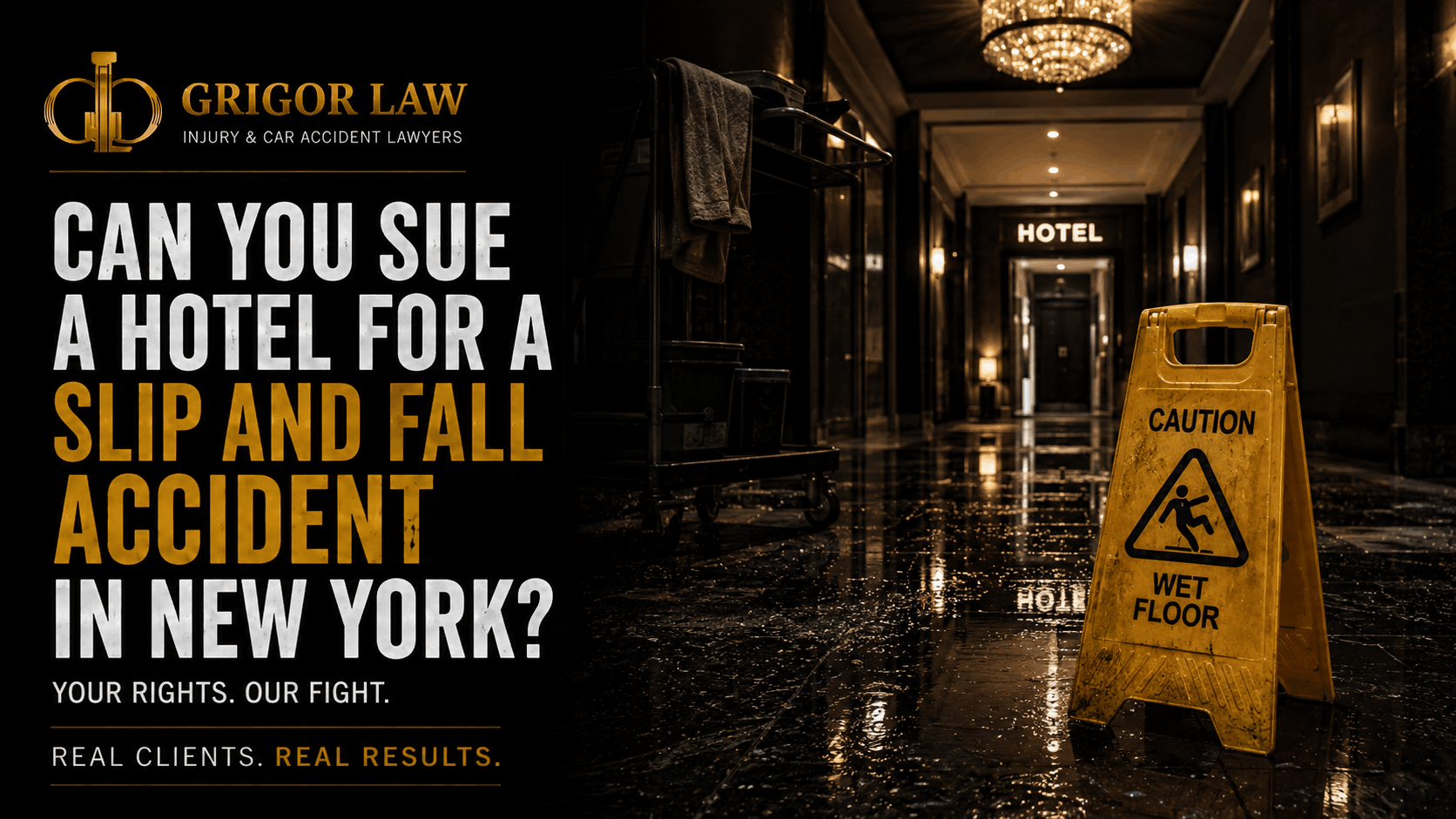
Yes, you can sue a hotel for a slip and fall accident in New York. Hotels have a legal duty to keep their property safe, and when they fail to fix dangerous conditions, they can be held financially responsible for your injuries.
This article explains how New York premises liability law applies to hotel accidents, what you need to prove, who can be held responsible, and what steps to take right after a fall to protect your claim.
If you were hurt at a New York hotel, here’s what you need to know.
Can You Sue a Hotel for a Slip and Fall in New York?
Yes, and hotels get sued for this more often than you might think. If a dangerous condition on the property caused your fall, the hotel may be legally responsible for your injuries and your losses.
Hotels owe every guest a duty of care. That’s a legal obligation to keep the property reasonably safe. When they ignore hazards, skip maintenance, or let dangerous conditions go unfixed, they can be held accountable through a premises liability claim, a lawsuit against a property owner for failing to maintain a safe environment.
When Is a Hotel Legally Responsible?
A hotel becomes liable when it knew, or should have known, about a dangerous condition and failed to fix it. New York courts use a reasonable care standard, which means the hotel must take the same precautions any responsible property owner would take.
This duty applies to everyone on the property:
● Paying guests checking into their rooms.
● Visitors attending events, weddings, or conferences.
● Anyone meeting a friend in the lobby or using hotel amenities.
The key legal concept here is foreseeability, if the hotel could reasonably predict that a hazard might injure someone, they had a responsibility to address it.
What You Need to Prove
To win a hotel slip and fall case in New York, you need to establish four things:
● A dangerous condition existed: A wet floor, broken stair, poor lighting, or another hazard was present on the property.
● The hotel had notice: They created the hazard, knew about it, or should have discovered it through regular inspections.
● The hazard caused your fall: There’s a direct link between the unsafe condition and your injury.
● You suffered real losses: Medical bills, missed work, pain, measurable harm resulted from the fall.
Notice is usually where hotel cases are won or lost. There are three types New York courts recognize:
● Actual notice: Staff saw the hazard or were directly told about it.
● Constructive notice: The hazard existed long enough that a reasonable inspection would have caught it, like a spill sitting for two hours in a busy lobby.
● Created condition: A hotel employee caused the hazard, such as mopping a floor without posting a warning sign.
Where Hotel Slip and Falls Happen
Dangerous conditions show up in predictable places. Knowing where they occur most often can help you understand whether your situation qualifies.
High-risk areas include:
● Entrances and lobbies: Rain, snow, and slush tracked in from outside make floors dangerously slippery, especially during bad weather.
● Pool decks and spas: Standing water and steam condensation create constant slip hazards. New York health codes require slip-resistant surfaces in these areas.
● Stairwells and hallways: Worn carpet, missing handrails, and dim lighting are common, and preventable, causes of serious falls.
● Guest bathrooms: Slippery tile, missing bath mats, and plumbing leaks are frequent culprits, and falls in these spaces often cause severe injuries due to hard surfaces.
● Sidewalks and parking lots: Hotels are responsible for adjacent sidewalks under New York City law, as well as parking areas with potholes, cracked pavement, or poor lighting.
Who Can Be Held Responsible
It’s not always just the hotel. New York hotels often operate through multiple business layers, and more than one party may share legal responsibility for your injuries.
● The property owner may be a separate entity from the company running the hotel.
● The hotel operator or management company has independent duties to maintain safe conditions.
● Third-party contractors hired for cleaning, snow removal, elevator maintenance, or security can be liable when their negligence creates or fails to correct a hazard.
● Franchise brands sometimes share liability when they control safety standards or staff training, even if a local franchisee owns the building.
Identifying every responsible party matters because each may carry separate insurance, which can directly affect how much compensation you recover.
What to Do Right After a Hotel Fall
Evidence disappears fast. Surveillance footage is often retained only for a limited time, so act quickly to preserve it. How you act in the hours after your fall can make or break your case.
- Get medical care right away, even if you feel okay. Adrenaline masks pain, and some injuries don’t show up until days later.
- Report the fall to hotel management and ask for a written incident report. Request a copy before you leave.
- Photograph everything, the hazard, the lighting, your shoes, your injuries, and the surrounding area.
- Get contact information from any witnesses and the hotel staff who responded.
- Keep your shoes and clothing exactly as they were. Do not wash them.
- Don’t give a recorded statement to the hotel’s insurance company or sign anything without speaking to an attorney first.
- Call a lawyer the same day so they can send a preservation letter, a formal legal demand requiring the hotel to save surveillance footage, maintenance records, and incident reports.
What Evidence Strengthens Your Case
The most valuable evidence in a hotel slip and fall case is usually controlled by the hotel itself. That’s why acting fast, and having an attorney act on your behalf, is so important.
● Surveillance footage captures exactly what happened and whether staff responded.
● Maintenance and housekeeping logs reveal whether the hotel regularly inspected the area or ignored known problems.
● Prior incident reports show whether other guests were hurt in the same spot, powerful proof that the hotel had notice.
● Your footwear matters more than most people realize. Insurance companies frequently argue that your shoes caused the fall. Preserving them lets your attorney shut that argument down.
What Compensation You Can Recover
New York law allows you to recover two categories of damages. Economic damages are your measurable financial losses. Non-economic damages cover the physical and emotional toll of the injury.
● Medical expenses, including future treatment and rehabilitation.
● Lost wages and reduced earning capacity if the injury affects your ability to work.
● Out-of-pocket costs like transportation to appointments or medical equipment.
● Pain and suffering, emotional distress, and loss of enjoyment of life.
The value of your case depends on the severity of your injuries, how clearly the hotel was at fault, and how the accident has affected your daily life. We never make promises about specific dollar amounts, but we fight to make sure nothing gets left on the table.
How Long You Have to File in New York
In most cases, you have three years from the date of your fall to file a personal injury lawsuit in New York. But there are important exceptions that shorten that window:
● City or state-owned property: You must file a Notice of Claim within 90 days and sue within one year and 90 days.
● Wrongful death: Families have two years from the date of death.
Three years sounds like a long time, but evidence disappears, witnesses forget details, and video gets overwritten long before that deadline arrives. The sooner you act, the stronger your case.
What If You Were Partly at Fault?
You can still recover compensation even if you were partly responsible for the fall. New York follows pure comparative negligence, which means your payout is reduced by your share of fault, but never eliminated entirely.
For example, if a jury finds you 25% at fault for not watching where you were walking and the hotel 75% at fault for leaving a spill unattended, you would still recover 75% of your total damages (75% at fault).
Defenses Hotels Commonly Use
Hotels and their insurers will push back. Knowing their playbook helps you prepare.
● “It was open and obvious”: They’ll argue the hazard was so visible you should have avoided it. In New York, this can reduce their liability, but it doesn’t eliminate it. They still had a duty to fix it.
● “It was a trivial defect”: They’ll claim a trivial defect doesn’t count as a dangerous condition. Courts look at the size, location, and circumstances, not just the defect itself.
● “We posted a wet floor sign”: A sign doesn’t automatically protect them. If the area was still unreasonably dangerous, the sign doesn’t end the analysis.
● “It was snowing”: The storm in progress doctrine means hotels generally aren’t required to clear snow mid-storm. But they must act within a reasonable time once it stops, and weather records often prove whether they did.
Injured at a New York Hotel? We’re Here to Help
A hotel fall can disrupt your work, your health, and your family’s finances. You shouldn’t have to navigate a corporate insurance defense team on your own.
At Grigor Law Injury & Car Accident Lawyers, Chrissy Grigoropoulos, Esq. recognized among Top 40 Under 40 Rising Stars and the American Institute of Personal Injury Attorneys’ 10 Best Female Attorneys for Client Satisfaction, leads a team that fights hard for injury victims across New York. We’re available 24/7, offer free consultations, and charge no fees unless we win your case. Our team speaks Spanish, Greek, French-Creole, and Korean.
Call (718) 808-9309 or visit grigorlaw.com to get started today.
Frequently Asked Questions
Does a Wet Floor Sign Protect the Hotel from Liability?
Not automatically. If the sign was poorly placed, missing when the hazard was at its worst, or the area was still unreasonably dangerous despite the warning, the hotel can still be held liable.
Can I File a Claim if I Live Outside New York?
Yes. If you were injured at a New York hotel, New York courts have jurisdiction regardless of where you live. We handle cases remotely by phone, email, and video, you don’t need to travel back.
Should I Give a Recorded Statement to the Hotel’s Insurance Company?
No. Insurance adjusters are trained to use your own words against you. Speak with an attorney before giving any statement or signing any documents.
What If I Fell on the Sidewalk Outside the Hotel?
Under New York City law, the adjacent property owner, typically the hotel, is responsible for maintaining the sidewalk. You may have a claim against the hotel, not the city.
Can Hotel Employees File Both Workers’ Comp and a Lawsuit?
Yes. If you were hurt on the job at a hotel, you can file a workers’ compensation claim against your employer and a separate third-party lawsuit against any outside contractor or vendor whose negligence contributed to your injury.
How Long Do Hotel Slip and Fall Cases Take to Resolve?
Most cases settle or go to trial within one to three years, depending on the severity of your injuries, how clearly liability can be established, and whether the hotel’s insurer negotiates in good faith.