(718) 249-7447
 Call Us Now


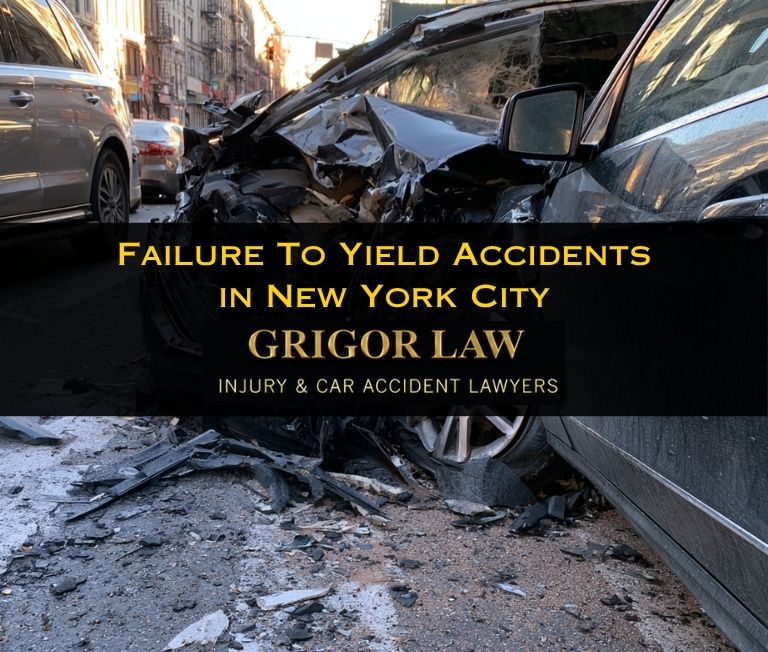
A failure to yield car accident occurs when a driver ignores their legal duty under New York Vehicle and Traffic Law Sections 1140 through 1146 to give another driver, cyclist, or pedestrian the right-of-way, and a collision follows.
This is negligence under New York law, and it gives you the right to hold that driver financially accountable for your medical bills, lost wages, and pain and suffering.
Who Is Liable for a Failure to Yield Crash?
In most crashes, the driver who failed to yield is the primary at-fault party. To build your case, you must show the driver owed you a duty to yield, broke that duty, and that breach directly caused your injuries.
But the non-yielding driver is not always the only responsible party. Others can share liability too:
- An employer: If the driver was on the job, delivering packages, working a rideshare shift, or operating a commercial truck, their employer may share liability.
- The City or MTA: A broken traffic signal, a missing sign, or a negligent city vehicle driver can shift legal responsibility to a government entity.
- A vehicle owner: An owner who lends their car to an unlicensed or impaired driver can be held financially responsible for the resulting crash.
Common Failure to Yield Crashes in NYC
Failure to yield crashes follow the same predictable patterns across the five boroughs. Knowing them helps you understand what happened, and why you have a case.
Left Turns at Intersections
A driver turning left must yield to all oncoming traffic before proceeding. This is the most common failure-to-yield crash in New York City, and when a car cuts across traffic without yielding, the resulting broadside impact is one of the most deadly intersection collisions on the road.
Crosswalks and Pedestrians
Drivers must stop for pedestrians in every crosswalk, marked or unmarked, including when turning on a green light or making a right-on-red. Children, seniors, and people with disabilities are especially vulnerable when drivers ignore this duty.
Merges and Lane Changes
Drivers entering a highway must yield to traffic already on the road. When changing lanes, you must yield to vehicles that already occupy the lane you are entering.
Driveways and Parking Exits
Any driver exiting a driveway, alley, or parking lot must yield to all vehicles and pedestrians on the main road and sidewalk before pulling out.
Bike Lanes and Turning Drivers
Before crossing a bike lane to turn, a driver must yield to cyclists in that lane. “Right hook” and “left cross” collisions, where a turning car cuts off a cyclist, are among the leading causes of serious bicycle injuries across the city.
One pattern we consistently see in failure to yield claims across New York City is that adjusters lean hardest on the left turn and merge cases, arguing the other driver could have braked in time.
We regularly pull signal timing data and DOT camera footage from intersections along Queens Boulevard and the Grand Central Parkway to show exactly when the right of way shifted. That evidence is often the difference between a denied claim and a fair settlement.
What Evidence Proves Failure to Yield?
These cases often come down to one driver’s word against the other, and insurance companies count on that confusion to pay you as little as possible. We move immediately to lock down hard evidence before it disappears.
- Traffic and dash camera video: Footage from NYC DOT cameras, nearby businesses, and in-car dash cams is the most powerful evidence in a failure-to-yield case. Surveillance and dash camera footage can be erased quickly, so it’s crucial to preserve it immediately.
- Witness statements and 911 recordings: Independent witnesses have no stake in the outcome and carry real weight with insurers and juries. The 911 audio captures unfiltered accounts from the moments right after the crash.
- Signal timing records: We subpoena DOT data showing the exact traffic light sequence at the time of impact, proving definitively who had the green.
- Vehicle damage photos: The location of damage tells the story. A turning car with front-end damage that struck another vehicle’s passenger side is a textbook failure-to-yield T-bone.
- The police report: The official MV-104AN accident report documents the responding officer’s observations, any VTL tickets issued, and the contributing factors recorded at the scene.
A tactic our New York City car accident lawyers see repeatedly from insurers handling failure to yield claims in New York City is delay, hoping traffic camera footage gets overwritten and witnesses become impossible to locate before a claim is filed.
We send preservation letters to the NYPD and NYC DOT within days of taking a case, and we have retrieved footage in Kings County and Bronx County claims that adjusters assumed was already gone.
What to Do after a Failure to Yield Crash in NYC
The steps you take right after a crash directly affect what you can recover. Follow this sequence.
Call 911 and See a Doctor Immediately
Always call 911 and get a police report filed at the scene. Then see a doctor as soon as possible, even if you feel fine. Injuries like concussions and soft tissue damage can take days to surface, and any gap in your medical record gives the insurer an excuse to dispute your claim.
File Your No-Fault Application within 30 Days
New York is a no-fault state, meaning your own auto insurer pays your initial medical bills and a portion of lost wages, up to $50,000 in basic benefits, regardless of who caused the crash. You must file the NF-2 Application for No-Fault Benefits within 30 days of the accident or you forfeit those benefits entirely.
Preserve Evidence and Get Witness Information
Photograph both vehicles, the road, any traffic signs or signals, and your visible injuries. Get the names and phone numbers of any witnesses before they leave the scene.
Do Not Give a Recorded Statement to the Other Insurer
The at-fault driver’s insurance adjuster will call asking for a recorded statement. Do not give one. Adjusters are trained to use your own words against you. Their job is to protect the insurer’s money, not yours.
Call Grigor Law Right Away
Contact Gigor Law for a free consultation as soon as you are able. If you cannot travel, we come to you. You pay no legal fee unless we win your case.
Can You Sue beyond No-Fault in New York?
Yes, but only if your injuries meet the “serious injury” threshold under Insurance Law § 5102(d). No-fault covers medical bills and wages. A lawsuit is the only route to recovering pain and suffering.
Your injury qualifies as serious if it resulted in any of the following:
- A bone fracture
- Significant disfigurement
- Permanent loss of use of a body organ, member, function, or system
- Permanent consequential limitation of a body part
- Significant limitation of use of a body function or system
- A disability that prevented normal daily activities for 90 of the first 180 days after the crash
Meeting even one of these criteria gives you the right to sue the at-fault driver directly.
What Compensation Can You Recover?
We benchmark every case against New York and federal case law to demand full value, not the number an insurer hopes you will accept. Your recovery falls into two categories.
- Special damages cover measurable financial losses: medical bills beyond no-fault limits, future medical care, lost wages above the no-fault cap, and reduced earning capacity.
- General damages cover what no receipt can capture: your pain and suffering, emotional distress, and loss of quality of life since the crash.
In cases involving a drunk or reckless driver, you may also pursue punitive damages, an award designed specifically to punish especially dangerous conduct.
At Grigor Law Personal Injury & Car Accident Lawyers, what we see across the failure to yield claims we handle in New York City is that insurers undervalue general damages far more aggressively than the medical bills themselves, especially when a client’s injuries do not show up clearly on an X-ray.
We build the pain and suffering portion of a claim with treatment records from hospitals like Bellevue and Elmhurst, and that documentation regularly moves a lowball offer into six figures.
How Long Do You Have to File in New York?
Missing a legal deadline permanently ends your right to recover compensation. These limits are not negotiable.
| Claim Type | Filing Deadline |
| No-Fault Application (NF-2) | 30 days from crash |
| Personal Injury Lawsuit | 3 years from crash |
| Wrongful Death Claim | 2 years from date of death |
| Claim Against NYC or MTA | Notice of Claim within 90 days, lawsuit within 1 year and 90 days |
The city and MTA deadlines are where people most often lose their right to recover. If a government vehicle or road defect contributed to your crash, the clock started the day of the accident, not when you discovered the problem.
What If You Were Partly at Fault?
New York follows a pure comparative negligence rule. This means you can still recover even if you shared some responsibility. Your damages are simply reduced by your percentage of fault.
If you have $100,000 in damages and are found 20% at fault, you still recover $80,000. Insurance adjusters push hard to shift blame onto you because every percentage point they move in their direction is money they keep. Partial fault does not end your case.
How Does Grigor Law Fight for You?
We act the moment you call. Preservation letters go out to the DOT and local businesses the same day to secure video before it is deleted. We bring in accident reconstruction engineers who can prove scientifically how the crash happened and who had the right-of-way.
Our New York City personal injury lawyers coordinate directly with your treating physicians to build the medical record needed to satisfy the serious injury threshold. Every case is prepared for trial, because insurance companies know we will take a case to verdict, and that forces fair settlements instead of the lowball numbers they open with.
Why Choose Grigor Law for Your NYC Failure to Yield Case?
We have been fighting for injured New Yorkers since 2015. Founding attorney Chrissy Grigoropoulos, Esq., and our trial team, including Madalene Sabino and Michelle Jablonski, Esq., bring a shark attitude to every case and every negotiation.
- Three offices in Ridgewood, The Bronx, and Hempstead, covering all five boroughs, Long Island, and Westchester County.
- No fee unless we win, you owe us nothing unless we secure a financial recovery for you.
- We come to you, if your injuries prevent travel, we send an attorney directly to your location.
Get Legal Help Today
Do not let an insurance company put a number on your pain and your future. Contact Grigor Law Injury & Car Accident Lawyers for a free, confidential case evaluation today. Evidence disappears fast. Don’t wait.
Frequently Asked Questions
Does a Failure to Yield Ticket Prove Fault in a Civil Case?
A ticket is strong evidence but does not automatically win your civil lawsuit. You still need to prove the driver’s negligence caused your specific injuries and losses.
Can a Pedestrian Recover Compensation If They Were Hit outside a Crosswalk?
Yes. Under New York’s comparative negligence rule, a pedestrian struck outside a crosswalk can still recover damages, though their compensation may be reduced by their share of fault.
Can I Sue If I Swerved to Avoid a Driver Who Failed to Yield and Crashed?
Yes. If another driver’s failure to yield forced you into evasive action that caused injury, they can be held liable even if your vehicles never made contact.
What If the Driver Who Hit Me Had No Insurance?
You may be able to recover through your own Supplementary Uninsured Motorist (SUM) coverage, or through the Motor Vehicle Accident Indemnification Corporation (MVAIC), New York’s fund for victims of uninsured and hit-and-run drivers.
Do Claims Against the City of New York or MTA Have Different Deadlines?
Yes, claims against the City of New York or the MTA require a formal Notice of Claim and follow expedited procedural deadlines that differ from standard personal injury cases, so consult an attorney promptly.
How Quickly Is NYC Traffic Camera Footage Deleted?
Surveillance footage from DOT and private cameras is often overwritten quickly, which is why we send legal preservation letters the same day you call us.