(718) 249-7447
 Call Us Now


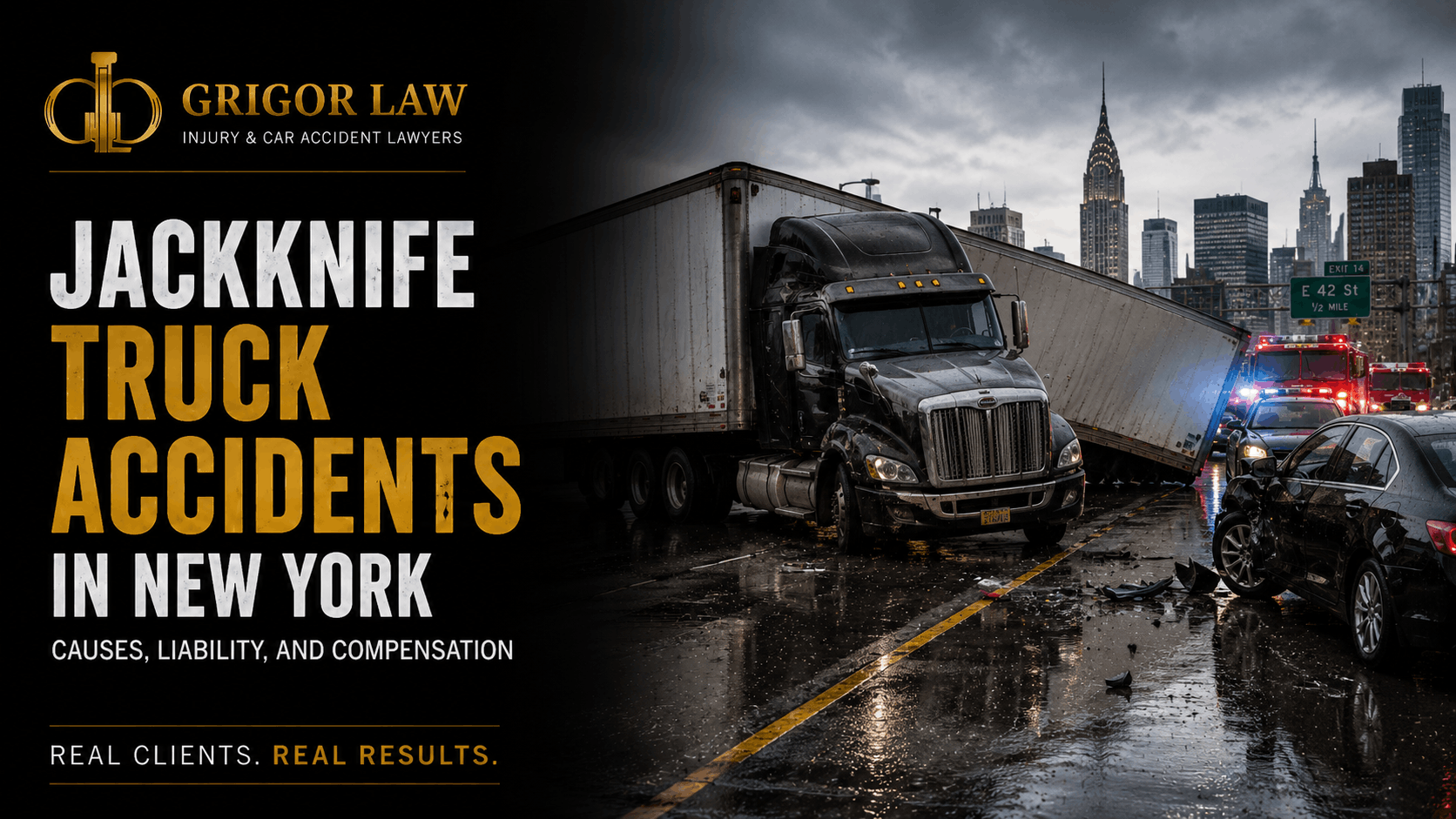
A jackknife truck accident happens when a tractor-trailer’s trailer swings out sideways from the cab, forming a sharp angle that blocks multiple lanes and leaves other drivers with no time to react. These crashes cause some of the most serious injuries on New York roads, and they almost always involve more than one responsible party.
This guide explains what causes jackknife accidents, who can be held liable under New York law, and what compensation you may be entitled to recover.
If you or someone you love was hurt in a jackknife crash, Grigor Law Injury & Car Accident Lawyers is here to help you understand your rights and take the right steps forward.
What Is a Jackknife Truck Accident?
A jackknife truck accident happens when a tractor-trailer’s cab and trailer fold into a sharp L or V shape, like a folding pocket knife snapping shut. This means the trailer swings out sideways, often crossing multiple lanes of traffic at once.
These crashes are especially dangerous in New York. On highways like the BQE, the LIE, and the Cross Bronx Expressway, a jackknifed rig can block traffic instantly and trigger chain-reaction pile-ups. Fully loaded commercial trucks can weigh as much as 80,000 pounds, so the impact on smaller vehicles is almost always severe.
What Causes a Truck to Jackknife?
Jackknifing doesn’t just happen, it’s almost always the result of driver error, equipment failure, or dangerous road conditions. Here are the most common causes:
● Speeding and hard braking: When a truck is going too fast and the driver brakes suddenly, the trailer’s momentum pushes it sideways.
● Slippery roads: Rain, snow, and ice reduce traction, making it easy for a trailer to slide out of control.
● Unsafe following distance: Trucks need far more stopping distance than cars. Tailgating in New York traffic leaves no room to react.
● Improperly loaded cargo: An unbalanced or overweight trailer shifts unpredictably during braking or turning.
● Brake failure: Worn brake pads or faulty air brake systems can cause axles to lock up mid-stop.
● Driver fatigue: Tired drivers react slowly and make poor braking decisions. Federal law limits how many hours a driver can work, but violations occur frequently.
● Sharp curves and sudden lane changes: Exit ramps and tight merges on New York roads can cause a trailer to swing if taken too fast.
Understanding the cause matters because it directly points to who is legally responsible for your injuries.
Who Is Liable for a Jackknife Truck Accident in New York?
Liability in a jackknife crash rarely falls on just one person. Multiple parties can share responsibility, and identifying all of them is key to maximizing your compensation.
● The truck driver: For speeding, driving while fatigued, distracted driving, or following too closely.
● The trucking company: For negligent hiring, poor training, or pushing drivers to meet unrealistic delivery deadlines.
● The cargo loader or shipper: For overloading the trailer or failing to distribute weight evenly.
● A maintenance contractor: For skipping inspections or performing faulty brake and tire repairs.
● The truck manufacturer: If a defective part, like a brake system or coupling, caused the crash, you may have a product liability claim.
● Another driver: If a passenger car cut off the truck and forced a sudden stop, that driver may share fault.
● A government entity: Potholes, missing signage, or poor road design can contribute to a crash. Note that claims against a municipality require a notice of claim to be filed within just 90 days.
Proving who is liable depends on the evidence, and that evidence disappears fast.
What Evidence Do You Need to Prove a Jackknife Truck Case?
Jackknife truck cases are built on technical, time-sensitive evidence. This is one of the biggest reasons why acting quickly, and hiring an attorney right away, makes such a difference.
One of the first things we do is send a spoliation letter. This is a formal legal notice demanding that the trucking company preserve all evidence before it gets destroyed or overwritten.
Key evidence in these cases includes:
● ELD data: An Electronic Logging Device (ELD) is the truck’s onboard recorder. It tracks speed, hard braking, and hours driven. This data can be legally overwritten in as little as 30 days.
● Driver logs: These records show whether the driver violated federal hours-of-service rules and was too fatigued to drive safely.
● Maintenance records: Inspection reports and repair invoices reveal whether the truck’s brakes, tires, or other systems were properly maintained.
● Scene evidence: Photos of the vehicles, skid marks, dashcam footage, traffic camera video, and witness statements all help reconstruct what happened.
While we work to lock down this evidence, here’s what you should do right after a crash.
What to Do After a Jackknife Truck Accident in New York
The steps you take in the hours after a crash can make or break your case.
1. Call 911 and get medical care immediately.
Even if you feel okay, internal injuries and concussions often don’t show up until hours later. A medical record also creates the foundation of your legal claim.
2. Document everything you can.
Take photos of the truck, its license plates, the DOT number on the cab, the road conditions, and your injuries. Get the names and phone numbers of any witnesses before they leave.
3. Don’t talk to the trucking company’s insurance adjuster.
Their job is to minimize what they pay you. They may call quickly and offer a low settlement or ask for a recorded statement. Politely decline until you’ve spoken with an attorney.
4. Contact a lawyer as soon as possible.
Time is critical. ELD data can disappear within weeks, and witness memories fade fast. We’re available 24/7 and offer free consultations in English, Spanish, Greek, French-Creole, and Korean.
How Does New York’s No-Fault Insurance Work After a Truck Crash?
New York is a no-fault state, which means your auto insurance covers your initial medical bills and lost wages up to $50,000, regardless of who caused the crash. This coverage is called Personal Injury Protection, or PIP.
But no-fault coverage has limits. To sue the at-fault driver or trucking company for pain and suffering, your injuries must meet what’s called the serious injury threshold under New York Insurance Law § 5102(d). This means your injuries must include a fracture, permanent limitation, significant disfigurement, or a disability lasting more than 90 days out of 180.
Because of the sheer force involved in jackknife crashes, victims very often meet this threshold, which opens the door to much larger compensation.
What Compensation Can You Recover?
When your injuries meet the serious injury threshold, you can pursue damages beyond what no-fault covers. Here’s a breakdown of what may be available to you:
| Type of Damages | What It Covers |
| Economic | Medical bills, future care costs, lost wages, lost earning capacity, property damage |
| Non-economic | Pain and suffering, emotional distress, loss of enjoyment of life |
| Wrongful death | Funeral costs, loss of financial support, loss of parental guidance |
| Punitive | Reserved for extreme misconduct, such as drunk driving or deliberate safety violations |
Commercial trucks are required to carry significant insurance, often $750,000 and over $1 million in liability coverage. The actual value of your case depends on the severity of your injuries, how strong the liability evidence is, and the coverage available.
How Long Do You Have to File a Claim in New York?
Don’t wait. Missing a deadline can permanently bar you from recovering anything, no matter how strong your case is.
● Personal injury claims: 3 years from the date of the crash.
● Wrongful death claims: 2 years from the date of death.
● Claims against a city or government agency: A notice of claim must be filed within 90 days, and additional, shorter filing deadlines may apply.
Even if you have three years, waiting hurts your case. Evidence disappears, witnesses become harder to locate, and memories fade. The sooner you act, the stronger your claim.
Can You Still Recover Compensation if You Were Partly at Fault?
Yes. New York follows a rule called pure comparative negligence. This means you can still recover compensation even if you were partially responsible for the crash, your award is simply reduced by your percentage of fault.
For example, if your total damages are $500,000 but you were found 20% at fault for following too closely, you would still recover $400,000. Never assume you can’t recover just because you think you share some blame. Let an attorney evaluate the facts before you make that call.
How Grigor Law Fights for Jackknife Truck Accident Victims
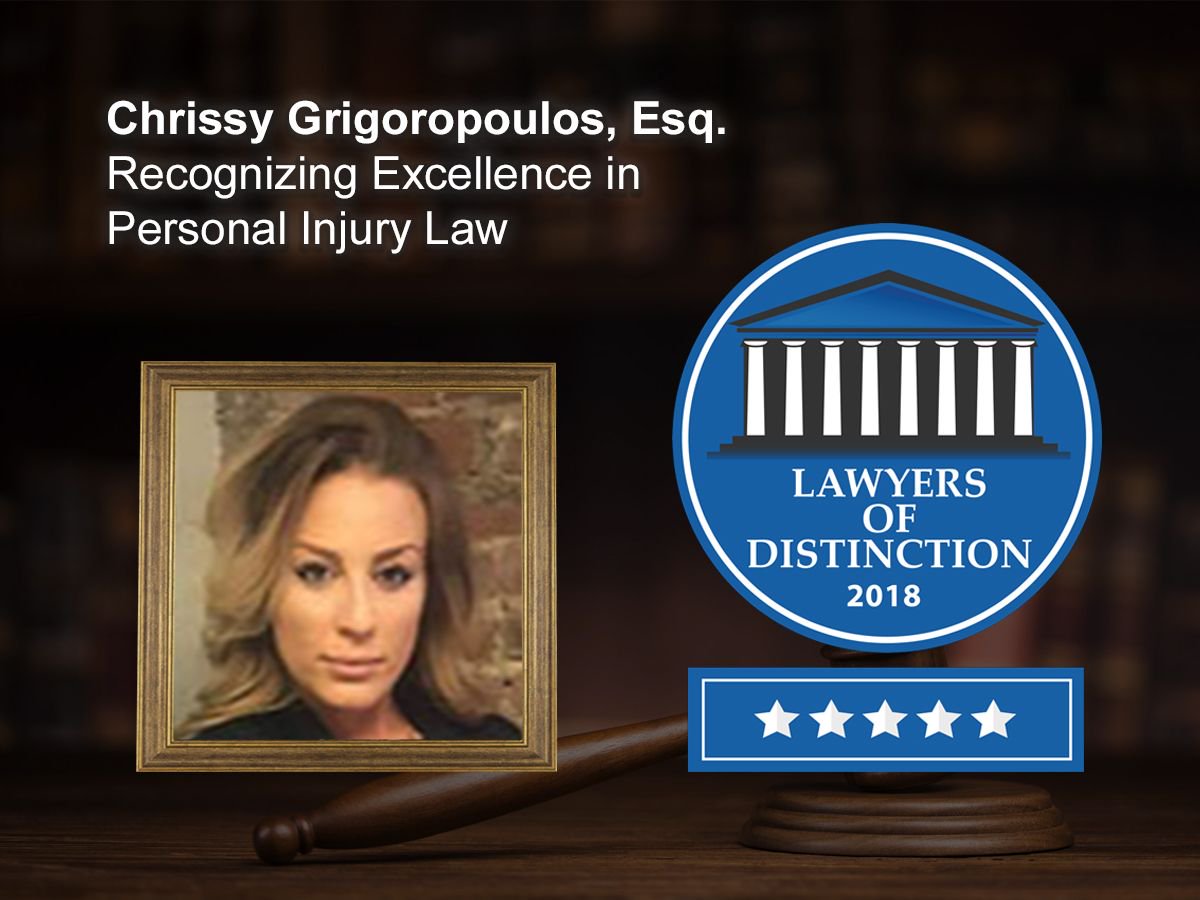
Grigor Law Injury & Car Accident Lawyers is led by Chrissy Grigoropoulos, Esq., a fierce trial attorney known throughout New York for her preparation, courtroom presence, and relentless advocacy for injury victims.
When you come to us, here’s how we approach your case:
● We move fast: We send spoliation letters within hours to lock down ELD data and dashcam footage before it’s gone.
● We bring in experts: We work with accident reconstruction engineers, trucking safety specialists, and medical professionals to build the strongest possible case.
● We document your losses: We work with your doctors, life-care planners, and vocational experts to make sure every economic and personal loss is accounted for.
● We fight at every stage: Insurance companies offer more when they know your lawyer is ready to go to trial. We are always ready.
● You pay nothing unless we win: We handle all personal injury cases on a contingency fee basis, meaning there are no upfront costs and no fees unless we recover money for you.
Talk to a New York Jackknife Truck Accident Lawyer for Free
You shouldn’t have to fight a trucking company and its insurers on your own. Grigor Law Injury & Car Accident Lawyers is here to protect your rights and fight for the compensation you deserve.
We offer free consultations, are available 24/7, and serve clients across all five boroughs, Nassau, Suffolk, Westchester, and parts of New Jersey. Call us today or submit our online contact form to get started, no fees unless we win.
Jackknife Truck Accident FAQs in New York
Is a Jackknife Crash Considered an Accident or Driver Error?
It’s legally classified as an accident, but the root cause is almost always driver error, equipment failure, or a combination of both, which is exactly why a liability investigation is so important.
Who Pays My Medical Bills Right After a Jackknife Crash in New York?
Your own auto insurance pays first under New York’s no-fault PIP coverage up to $50,000, regardless of who caused the crash. Once your injuries meet the serious injury threshold, you can pursue the at-fault party for additional compensation.
What Happens if the Truck’s Black Box Data Is Missing?
If a trucking company destroys evidence after receiving a spoliation letter, a New York court can issue sanctions against them and instruct the jury to assume the missing evidence would have hurt the defense.
Can I File a Claim if I Was the Truck Driver Who Jackknifed?
Possibly. If a defective part, poor maintenance, an unbalanced load, or another driver’s actions caused the crash, you may have a third-party claim in addition to your workers’ compensation benefits.
Do I Need a New York Attorney if the Crash Happened on the New Jersey Side of a Bridge?
Yes. Your residency, your insurance policy, and where you received treatment all affect where your case can be filed. A New York-licensed firm that handles cross-state claims can help you figure out the right path forward.