(718) 249-7447
 Call Us Now


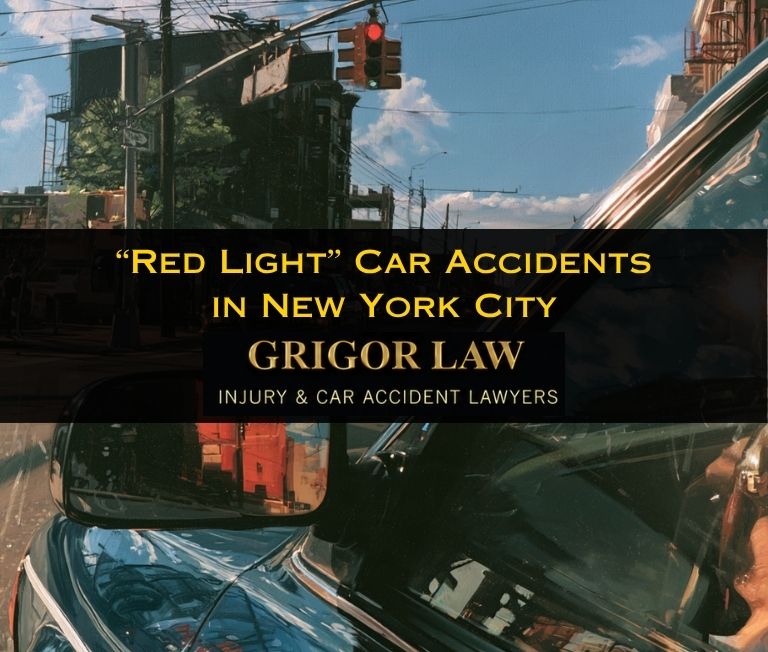
When a driver runs a red light and hits you in New York City, the law is on your side. Running a red signal violates Vehicle and Traffic Law §1111, which makes it negligence per se, meaning the violation itself proves fault without further argument.
In this article, you will discover who is liable after a red light crash, what compensation you can recover, how to prove the other driver ran the light, and how a Grigor Law car accident attorney in New York City fights for your full claim.
What Is a Red Light Car Accident in NYC?
A red light car accident happens when a driver enters an intersection against a red signal and strikes a vehicle, pedestrian, or cyclist who had the right of way. Under New York Vehicle and Traffic Law §1111, that driver broke the law, and in New York, that violation is treated as “negligence per se,” meaning the traffic ticket alone establishes their fault.
Most red light crashes produce T-bone collisions, where the front of one car drives directly into the side of another. The side panel of a vehicle offers almost no structural protection, which is why these impacts are so devastating.
Who Is Liable If a Driver Runs a Red Light?
The driver who ran the red light is the obvious starting point, but they are rarely the only responsible party. New York law allows us to pursue every available source of compensation.
Depending on the facts of your crash, we may bring claims against:
- The At-Fault Driver: Their personal auto insurance policy responds first.
- An Employer or Rideshare Company: If the driver was working for Uber, Lyft, a delivery company, or a taxi fleet at the time of the crash, their employer’s commercial insurance, often worth $1 million or more, may apply instead.
- The City of New York: A broken, obstructed, or poorly timed traffic signal can make the city liable for your damages.
- A Bar or Restaurant: New York’s Dram Shop Act holds establishments accountable when they serve a visibly intoxicated person who then causes a crash.
Common Causes of Red Light Crashes in NYC
Drivers run red lights for predictable, preventable reasons, distracted driving, alcohol or drug impairment, speeding to beat a changing signal, road rage, drowsy driving, and reduced visibility in bad weather. Every one of them is a choice that put your life at risk.
Wide, multi-lane corridors like Queens Boulevard, Atlantic Avenue, and Northern Boulevard see especially deadly crashes because drivers accelerate aggressively and misjudge signal timing.
A pattern we see often on Queens Boulevard and Atlantic Avenue is a driver claiming the light was still yellow when the signal timing data says otherwise by a full second or more. We pull that timing record from NYC DOT before the insurer has a chance to build its own version of events.
Injuries Common in Red Light and T-Bone Collisions
When a car drives into your door at full speed, the force is delivered directly through the weakest part of your vehicle. The injuries that follow are often catastrophic and life-altering.
The crashes we handle most often produce:
- Traumatic Brain Injury (TBI): The violent snapping motion of a side impact causes concussions, brain bleeds, and lasting cognitive damage.
- Spinal Cord Injuries: Herniated discs, nerve damage, and, in the worst crashes, permanent paralysis.
- Bone Fractures: Broken ribs, hips, and pelvis are common in T-bone crashes, a fracture automatically qualifies as a “serious injury” under New York law.
- Internal Organ Damage: A ruptured spleen or liver can cause life-threatening internal bleeding with no immediate symptoms.
- Psychological Trauma: PTSD, driving phobia, and severe anxiety are compensable injuries that belong in your claim.
These classifications matter beyond the medical impact, they determine whether you can file a lawsuit and recover for your pain and suffering.
Can You Sue Beyond No-Fault After a Red Light Crash?
New York is a “no-fault” state. This means your own auto insurer pays your initial medical bills and a portion of your lost wages through Personal Injury Protection (PIP) benefits, regardless of who caused the crash.
But no-fault does not cover pain and suffering. To sue the at-fault driver for full compensation, your injuries must meet the “serious injury threshold” under New York Insurance Law §5102(d). Qualifying injuries include:
- A bone fracture
- Significant disfigurement or permanent scarring
- Permanent loss of use of a body organ, member, or system
- Significant limitation of a body function or system
- A disability that substantially prevents you from performing daily activities during the recovery period after the crash.
- Death
Given the physics of a T-bone collision, most red light crash victims meet this standard.
What Compensation Can You Recover in New York?
Once your injuries qualify, we fight for every dollar you are owed across every category of loss. The insurance company will rush you a settlement offer. That offer is built to protect their profits, not your future. Do not accept it without speaking to us first.
Compensation falls into two categories:
- Special Damages (Economic Losses): Past and future medical bills, lost wages, reduced earning capacity, and property damage.
- General Damages (Non-Economic Losses): Physical pain and suffering, emotional distress, loss of enjoyment of life, and permanent disfigurement.
New York places no cap on personal injury damages. Our Queens personal injury lawyers benchmark your case against real jury verdicts to make sure any offer on the table reflects what you are actually owed.
How Do You Prove the Other Driver Ran the Red Light?
The other driver’s insurer will look for every angle to deny your claim. We counter with evidence they cannot dispute, and we move to secure it the moment we take your case.
What we see repeatedly in T-bone claims out of our Ridgewood office is a business surveillance camera pointed just close enough to the intersection to catch the crash, but the footage gets recorded over within a week if nobody asks for it. We send a preservation letter to every nearby business the same day we are retained.
Traffic and Red Light Camera Evidence
NYC DOT operates red light and traffic cameras in the city, if footage exists, request its preservation as soon as possible. We send legal preservation demands to the city the same day we take your case.
Police Reports and Vehicle “Black Box” Data
The NYPD accident report (Form MV-104A) documents any VTL §1111 violation the responding officer observed. Modern vehicles also carry an Event Data Recorder (EDR), a black box that captures speed and braking data in the seconds before impact. A driver who never touched the brakes has no credible defense.
Witnesses, Dashcams, and Business Surveillance Footage
Pedestrians, nearby drivers, and local workers often see exactly what happened. Business cameras at bodegas, gas stations, and parking lots frequently capture intersections directly. We track down witnesses immediately and demand preservation of business surveillance footage before it is overwritten.
What Should You Do After a Red Light Crash in NYC?
What you do in the hours after the crash directly shapes the strength of your claim. Follow these steps without delay.
- Call 911 immediately. A police report locks in the scene, documents traffic violations, and creates the foundation of your claim.
- Get medical attention the same day. TBI and internal injuries can stay silent for hours, a same-day medical record directly connects your injuries to the crash.
- Photograph everything you can. Vehicle positions, traffic signals, skid marks, and visible injuries.
- Collect witness contact information. Names and phone numbers before anyone leaves the scene.
- Do not apologize or admit fault. Anything you say can be used against you under New York’s comparative negligence rules.
- File Form NF-2 within 30 days. This no-fault application activates your PIP benefits, miss the deadline and your coverage can be denied entirely.
- Call us before you talk to any adjuster. Insurance adjusters are trained to extract statements that will damage your case. Contact Grigor Law first.
Special Situations in NYC Red Light Cases
Pedestrians and Cyclists in the Crosswalk
If you were on foot or on a bike and struck while crossing with the walk signal, you had the absolute right of way. You typically face no comparative fault argument, and your injuries almost always meet the serious injury threshold, making these some of the strongest claims we handle.
Hit-and-Run and Uninsured Drivers
If the driver who hit you fled or carried no insurance, you still have a path to recovery. Your own policy’s Uninsured Motorist (UM) coverage is designed to step in and pay your damages. If you have no UM coverage, New York’s Motor Vehicle Accident Indemnification Corporation (MVAIC), a state fund created for victims of uninsured and hit-and-run drivers, may cover you instead.
Defective Signals and the 90-Day Notice of Claim
When a broken, obstructed, or mistimed traffic signal contributed to your crash, a claim against the City of New York or NYSDOT may apply. You must file a formal Notice of Claim within 90 days under General Municipal Law §50-e. Miss that window and your right to sue the city is gone permanently.
How Does Partial Fault Affect Your NYC Case?
The other driver’s insurer may argue you share some of the blame, that you were speeding, that you reacted slowly, or that you were distracted. Under New York’s comparative negligence rule (CPLR § 1411), partial fault does not stop your recovery, unless your fault turns out to be greater than the other driver’s, a bar that took effect May 26, 2026.
Your total award is simply reduced by your percentage of fault. If a jury finds you 10% responsible on a $200,000 claim, you still recover $180,000. We fight to put every percentage point of blame on the driver who ran that red light.
How Long Do You Have to File a Claim in NYC?
New York law sets hard, non-negotiable deadlines. Missing any one of them permanently ends your right to compensation.
| Deadline | Action Required | Legal Authority |
| 30 days | File NF-2 no-fault application with your insurer | Insurance Law §5103 |
| 90 days | File a Notice of Claim against a city or state agency | GML §50-e |
| 2 years | File a wrongful death lawsuit | EPTL §5-4.1 |
| 3 years | File a personal injury lawsuit | CPLR §214 |
The clock starts the moment the crash happens, not when you decide you are ready to act.
How We Fight for You at Grigor Law
When insurance companies see Grigor Law on the other side, they know this case is going to trial if they refuse to pay what you deserve. We negotiate from strength, and they know it.
From our offices in Ridgewood, the Bronx, and Hempstead, we fight for clients across all five boroughs, Long Island, and Westchester. Here is what that looks like from day one:
- We preserve evidence immediately. Preservation demands go out within hours of being retained, camera footage, EDR data, and witness information secured before it disappears.
- We file your NF-2 paperwork. We handle your no-fault application before the 30-day deadline so your medical bills are covered while we build your case.
- We come to you. If your injuries prevent travel, our attorneys meet you wherever you are, no need to leave your home or hospital.
- You pay nothing unless we win. Contingency fee only, no upfront costs, no risk.
Contact an NYC Red Light Accident Lawyer Today
Camera footage is being overwritten right now. The insurance adjuster on the other side is already building a file against you. Every day without representation is leverage you are handing over.
Call Grigor Law at (718) 249-7447 for a free consultation. We serve all five boroughs, Long Island, and Westchester County from our offices in Ridgewood, the Bronx, and Hempstead. No fee unless we win.
Frequently Asked Questions
Who Pays My Medical Bills Before My Case Settles?
Your own auto insurer covers your medical bills through no-fault PIP benefits regardless of fault. We handle the NF-2 paperwork within the 30-day deadline to make sure your coverage starts immediately.
How Fast Do I Need to Submit the No-Fault NF-2 Application?
You have 30 days from the date of the crash. Miss that deadline and your insurer can deny your entire no-fault benefits claim.
Can I Get Red Light or Intersection Camera Footage After a Crash?
Yes, but only if you act quickly, because NYC DOT often deletes footage within days. We send a legal preservation demand the same day we take your case.
What If the At-Fault Driver Claims the Light Was Yellow?
Camera footage, witness accounts, and EDR black box data typically resolve that dispute fast. A driver who never touched the brake cannot credibly argue they entered on yellow.
Can I Recover Compensation If I Was Partially at Fault?
Yes, in most cases. New York’s comparative negligence rule reduces your award by your percentage of fault rather than eliminating your right to recover, unless your fault is greater than the other driver’s, a bar that took effect May 26, 2026.
What Happens If the Driver Who Hit Me Had No Insurance?
Your own policy’s Uninsured Motorist (UM) coverage steps in to pay your damages. If you have no UM coverage, New York’s MVAIC fund may provide an alternative path to compensation.
Can I Sue NYC If a Defective Traffic Signal Caused My Crash?
Yes, but you must file a formal Notice of Claim within 90 days under GML §50-e, miss that window and your right to sue the city is permanently gone.
Should I Give a Recorded Statement to the Insurance Adjuster?
No. Adjusters are trained to ask questions designed to get you to damage your own case. Call us at (718) 249-7447 before you speak to any insurer.