(718) 249-7447
 Call Us Now


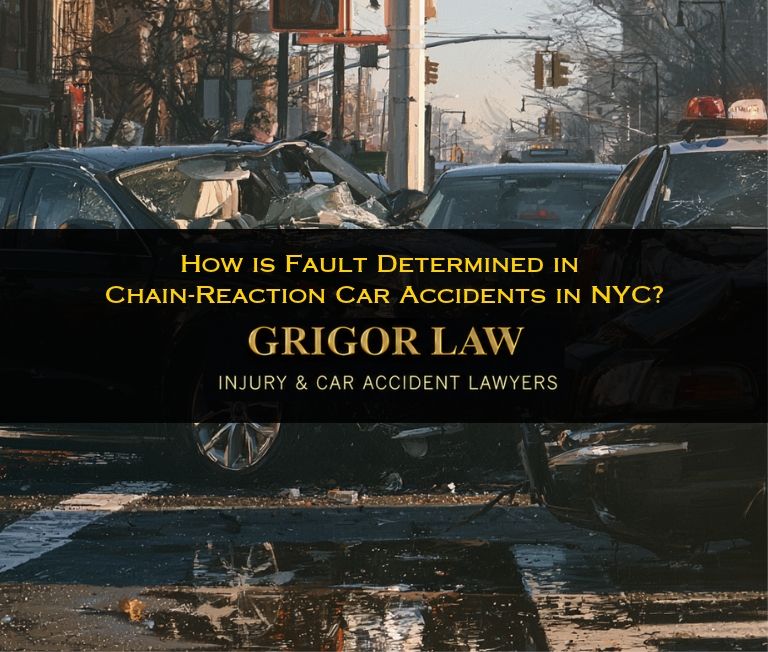
Liability in a New York City chain-reaction car accident usually starts with the driver who caused the first impact, but fault is often shared.
Other drivers, employers, vehicle owners, and government agencies can also be responsible. How fault is split decides how much you recover, and a 2026 change to New York’s comparative fault rule makes that split more important than ever.
In this article, you will discover who can be held liable in a NYC chain-reaction crash, how New York splits fault and pays for injuries, and how an attorney can prove the sequence of impacts and protect your recovery.
Who Is Liable in a New York City Chain Reaction Crash?
A chain-reaction car accident is a crash where one initial collision triggers a series of additional impacts involving three or more vehicles. Think of stopped traffic on the BQE: one distracted driver slams into the car ahead, that car gets pushed into the next one, and the chain continues down the line.
Liability means legal responsibility for causing harm to someone else. In most chain-reaction crashes, liability starts with the driver who caused the first impact, but multiple drivers can share fault depending on who was speeding, tailgating, or driving distracted.
New York’s Vehicle and Traffic Law (VTL § 1129) requires every driver to maintain a safe following distance. Any driver who violates that rule and sets off a pile-up can be held responsible for every collision that follows.
Liability rarely stops with just the drivers. Depending on the facts of your case, these parties may also be on the hook:
- The driver who caused the initial collision.
- A middle driver who was tailgating or not paying attention at the time of impact.
- A commercial driver’s employer, such as a trucking or delivery company.
- A vehicle owner who negligently loaned their car to an unsafe driver.
- A manufacturer of defective parts like faulty brakes or tires.
- A government agency responsible for a dangerous road condition.
Our job is to identify every liable party, because more sources of coverage mean more compensation for you.
Does the Rear Driver Presumption Apply in Multi-Vehicle Collisions?
New York law presumes that a driver who rear-ends a stopped or slowing vehicle was negligent. This means the rear driver is automatically considered at fault unless they can prove a valid, non-negligent reason for the crash.
In a chain-reaction crash, this rule works differently for middle drivers. If your vehicle was stopped safely and a rear impact pushed you into the car ahead, you are generally not held liable for that secondary collision. The fault lands on the driver who struck you from behind.
Do not let an adjuster convince you that bad weather gets anyone off the hook. New York courts have consistently held that rain, snow, and ice require drivers to slow down and increase their following distance, not that they are excused from negligence.
On stop-and-go stretches like the Gowanus Expressway and the Major Deegan, the middle driver is often the one insurers try to blame first. The rear driver’s insurer may claim the middle car stopped short, while the front driver’s insurer says the middle car hit them before being pushed.
In our experience, the answer usually comes down to timing: whether there was one impact or two, and how far apart they were.
How Is Fault Split in New York?
New York has long followed a rule called pure comparative negligence, which means you can recover compensation even if you were partly to blame for the crash, with your award reduced by your share of responsibility.
Car crash cases now have an important limit. Under a 2026 amendment to CPLR § 1411, in motor vehicle lawsuits filed on or after May 26, 2026, you cannot recover if your fault is greater than the combined fault of the defendants.
If you are found 20% at fault, your recovery is reduced by 20%. In a pile-up, where fault is often spread across several drivers, the way your share is calculated can decide whether you recover at all.
Here is how New York’s fault-splitting rules affect what you actually collect:
- Economic damages: These are concrete financial losses, such as medical bills and lost wages. Any at-fault driver can be held fully responsible for the total amount, regardless of their exact share of fault.
- Non-economic damages: This is your compensation for pain and suffering. A driver found 50% or less at fault would normally pay only their proportional share, but CPLR § 1602 makes an exception for claims arising from the use or operation of a motor vehicle, so in most car crash cases each at-fault driver can be held responsible for the full amount.
- Your own partial fault: Reduces your recovery, and in motor vehicle lawsuits filed on or after May 26, 2026, bars recovery entirely if your fault is greater than the combined fault of the defendants.
Insurance adjusters will try to push as much blame onto you as possible to shrink their payout. We fight to keep responsibility exactly where it belongs.
What Evidence Proves the Sequence of Impacts?
Winning a chain-reaction case requires proving exactly who hit whom, in what order, and why. Insurance companies will try to blur the timeline to limit what they owe. We use hard physical evidence to lock down the facts.
Photos, Video, and Vehicle Positions
The damage pattern on each vehicle tells the story of what happened. Heavy rear damage with only minor front damage on a middle car is strong evidence that it was pushed forward, not the cause of the secondary crash. We study the final resting positions of vehicles, paint transfer marks, and the depth and pattern of every impact.
Police Reports, Witnesses, and 911 Audio
The official police report (Form MV-104A) is our starting point, but it rarely tells the complete story. Independent witness statements and the timestamps on 911 recordings help establish exactly when and in what order each impact occurred.
Black Box Data and Accident Reconstruction
Most modern vehicles contain an Event Data Recorder (EDR), a device that logs your speed, braking, and steering inputs in the seconds before a crash.
We move quickly to recover dashcam footage, business surveillance video, and NYC DOT traffic camera footage before it is overwritten. For complex pile-ups, we bring in licensed accident reconstruction experts who use crash physics to build an irrefutable sequence of events.
One pattern we see repeatedly is a police report that lists the vehicles in the wrong order. Officers arriving at a pile-up on the Cross Island Parkway or the FDR Drive often reconstruct the sequence from where the cars came to rest and from whoever is still talking at the scene.
When the report gets the order wrong, we use the damage patterns, 911 timestamps, and EDR data to correct it before an insurer treats it as the final word.
How Does No-Fault PIP Work in NYC?
New York is a no-fault state, which means your own car insurance pays your initial medical expenses and a portion of your lost wages, regardless of who caused the crash. This coverage is called Personal Injury Protection, or PIP.
PIP covers up to $50,000 in basic economic loss, including medical bills, 80% of your lost wages up to $2,000 per month, and other reasonable out-of-pocket costs like prescription medication.
You must file a No-Fault application (Form NF-2) with your own insurer within 30 days of the accident. Miss that window and your insurer can legally deny your claim unless you have a reasonable justification for filing late.
Can You Sue Beyond No-Fault for a Serious Injury?
PIP does not compensate you for pain and suffering. To recover those damages, you must file a personal injury lawsuit, but only if your injuries meet New York’s serious injury threshold.
To qualify, your injury must fall into at least one of these legally recognized categories:
- Death or dismemberment.
- A bone fracture.
- Significant disfigurement.
- Permanent loss or limitation of use of a body organ, member, or function.
Insurance companies fight aggressively to argue that your injuries do not qualify. We use your medical records and expert testimony to prove exactly how serious your condition is and what compensation you are owed.
What Damages Can You Recover in a Multi-Vehicle Crash?
When your injuries cross the serious injury threshold, we pursue every dollar the law allows. New York recognizes two types of recoverable damages.
Special damages are your measurable financial losses:
- Past and future medical expenses.
- Lost wages and loss of future earning capacity.
- Property damage to your vehicle.
General damages compensate you for how the crash has affected your life:
- Pain and suffering.
- Mental anguish and emotional distress.
- Loss of enjoyment of life.
What If a City Bus, Truck, or Employer Vehicle Is Involved?
When a commercial vehicle, such as an MTA bus, a delivery truck, or a city sanitation vehicle, is part of the chain reaction, the employer can be held liable for the driver’s negligence under a legal principle called respondeat superior. This means the company or government agency is directly on the hook for your injuries.
Any claim against the City of New York, the MTA, or a public authority comes with a hard deadline: you must serve a formal Notice of Claim within 90 days of the accident. Miss this and your right to sue is permanently lost.
Commercial and government policies typically carry higher insurance limits than personal auto policies, which means more potential compensation when we can prove the connection. We act immediately to protect your rights.
What to Do After a Chain Reaction Crash in NYC?
The actions you take in the hours after a pile-up directly shape the strength of your claim.
Call 911 and Get Medical Attention
Report the accident immediately so an official police report is created. See a doctor right away, even if you feel fine, because adrenaline masks serious injuries, and any gap in your treatment is a weapon insurance adjusters will use against you.
Document the Scene and Collect Information
Photograph every vehicle, all visible damage, license plates, skid marks, and traffic signals. Collect driver’s licenses, insurance cards, and the contact information of every driver and witness at the scene.
Avoid Recorded Statements to the Other Insurance Company
The at-fault driver’s adjuster may call you within hours of the crash. They are not calling to help you. They are looking for something you say that they can use to deny or reduce your claim. You are not required to give a recorded statement, and you should not give one before speaking with us.
Call Grigor Law Injury & Car Accident Lawyers
Call us before you talk to any insurance company. We come to you at home, at the hospital, or at our offices in Ridgewood, the Bronx, or Hempstead. We serve all five boroughs, Long Island, and Westchester County, and we work on a contingency fee, meaning you pay us nothing unless we win. Call (718) 249-7447 today.
Deadlines That Apply to Your Injury Claim
New York law sets strict, unforgiving deadlines for every type of accident claim. Missing even one can permanently strip you of your right to compensation.
| Deadline | What It Covers | Who It Applies To |
| 30 days | No-Fault (PIP) application | Your own car insurance company |
| 90 days | Notice of Claim | City of New York, MTA, government entities |
| 1 year + 90 days | Lawsuit against a municipality | City, MTA, and other government defendants |
| 3 years | Personal injury lawsuit | Private at-fault drivers |
Evidence disappears long before these deadlines expire. Do not delay in getting help.
Frequently Asked Questions
Am I Liable If I Was Pushed Into the Car Ahead of Me?
Generally, no. If you were stopped safely and a rear impact forced your vehicle into the car ahead, New York courts typically hold the driver who started the chain reaction responsible, not you.
How Long Do I Have to File If the City of New York or the MTA Is Involved?
You have 90 days to serve a Notice of Claim and 1 year and 90 days to file your lawsuit. Miss either deadline and your right to sue is permanently gone, so call us immediately if any government vehicle was part of the crash.
Do I Have to Give a Recorded Statement to the Other Driver’s Insurance Adjuster?
No. You have no legal obligation to give a recorded statement to the at-fault driver’s insurer, and we strongly advise against doing so before you have spoken with us.
What Happens If the At-Fault Driver Was Uninsured or Underinsured?
Your own Uninsured/Underinsured Motorist (UM/SUM) coverage steps in to protect you, and we investigate every other available source of coverage, including household policies, employer vehicles, and umbrella policies, to maximize your recovery.
Can My Insurance Rates Increase If I Was Not at Fault in New York?
Under New York law, your insurer cannot legally raise your premium for an accident you did not cause, and if they try, we will help you fight back.
The insurance companies know we will take a case to trial. That is the leverage you want on your side. Call Grigor Law Injury & Car Accident Lawyers now at (718) 249-7447 for a free consultation. No fee unless we win, and we come to you.