(718) 249-7447
 Call Us Now


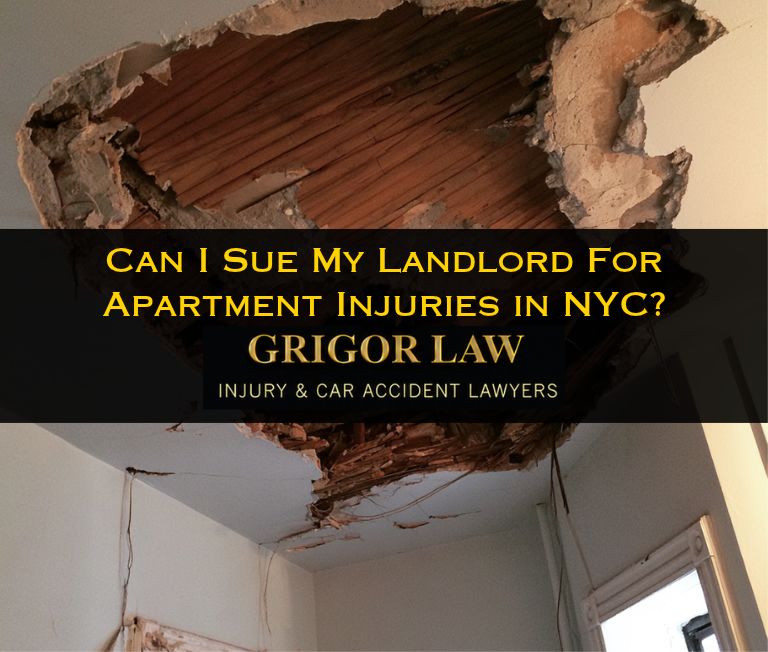
You can sue your landlord for an apartment injury in NYC when the landlord’s negligence caused it. New York law requires landlords of multiple dwellings to keep the entire property in good repair.
When they fail to fix a hazard they knew or should have known about, and you get hurt because of it, they can be held financially responsible.
In this article, you will discover when a landlord is liable, how to prove notice, and how an apartment injury attorney in New York City can help you recover full compensation.
When Is My Landlord Liable for an Apartment Injury in NYC?
Yes, you can sue your landlord for an injury in your NYC apartment. To win your case, you need to prove three things: a dangerous condition caused your injury, your landlord had a legal duty to fix it, and they failed to act in time.
New York’s Multiple Dwelling Law requires landlords with buildings of three or more units to keep the entire property in good repair. This is a non-negotiable legal obligation, not a suggestion.
You must also prove your landlord had notice, the legal term for what they knew and when. They either had actual notice, meaning you or another tenant reported the problem directly, or constructive notice, meaning the hazard existed long enough that any responsible owner should have found it during a routine inspection.
Can I Sue If I Was Hurt Inside My Apartment?
Many tenants assume their landlord is only responsible for shared spaces like hallways or stairwells. That is not how New York law works. Courts have confirmed that the duty to maintain good repair extends directly into your individual unit.
If your ceiling collapsed from a leak your landlord ignored, or a window fell because they refused to fix a broken sash, you have a case. Defective radiators, broken flooring, and faulty wiring inside your apartment can all support a valid lawsuit.
One critical point: if your lease includes language claiming the landlord is not responsible for accidents inside your apartment, that clause is unenforceable. No lease provision can override a landlord’s legal duty to provide a safe home.
What Building Conditions Create Landlord Liability?
Your landlord’s failure to fix a known hazard is at the core of premises liability law, the area of law that holds property owners accountable for injuries caused by unsafe conditions they failed to correct.
Here are the most common hazards we see in NYC apartment injury cases:
- Broken stairs: Loose steps, uneven risers, and cracked nosing are building code violations.
- Missing railings: Handrails are legally required on interior stairways.
- Poor lighting: New York law requires that hallways and stairways in multiple dwellings be kept adequately lit.
- Falling ceilings: These almost always result from water leaks a landlord already knew about and chose not to fix.
- Slippery surfaces: Wet lobbies, uncleared snow, and icy entryways are common, and preventable.
- Broken locks: A front door that lets strangers walk in can make a landlord liable for an assault on you.
- Lead paint and mold: NYC’s Local Law 1 places strict duties on landlords of pre-1960 buildings where a young child lives, and mold conditions can support a separate claim.
Why Good Repair Is Not Perfection
“Good repair” does not mean your landlord guarantees a flawless building. The law focuses on what is reasonable. A stair that broke the morning you fell is a very different case from one that has been visibly crumbling for months.
The timeline between when a hazard appeared and when you were hurt is often the most decisive fact in your case. The longer it went unaddressed, the stronger your negligence argument becomes.
What our personal injury attorneys see consistently in New York City apartment injury cases is that HPD violation records tell the story before any witness does. Buildings in the Bronx and Brooklyn with open violations for leaks, broken stairs, or defective lighting often show the same complaint filed months before our client was hurt. Those records, pulled from HPD Online along with 311 histories, are often the strongest proof of notice we have.
How Do I Prove the Landlord Knew or Should Have Known?
Notice is what decides most apartment injury cases. You need to show your landlord was aware of the hazard, or should have been.
There are two types of notice:
- Actual notice: Your landlord was told directly, by text, email, written complaint, or a conversation with the superintendent.
- Constructive notice: The hazard was visible and present for so long that a landlord running regular inspections should have found and fixed it.
Evidence That Proves Notice in an NYC Apartment Case
We build your notice argument using every available record. Evidence we look for from day one:
- Written complaints sent to your landlord or management company.
- Open or prior violations on file with the NYC Department of Housing Preservation and Development (HPD), which you can search online at no cost.
- 311 complaint records linked to your building address.
- Photographs showing long-term rust, wear, or deterioration.
- Statements from neighbors or building staff who witnessed the hazard before your accident.
- Maintenance logs, or the suspicious absence of them.
How to Preserve Evidence Before It Disappears
Evidence does not wait for you. Landlords and their insurance teams move fast to repair hazards and alter records the moment a claim becomes likely.
Photograph and video the dangerous condition immediately before anyone touches it. Send a written report to your landlord or management office that same day, and keep a copy. Then demand all surveillance footage from lobby cameras, stairwells, and elevators in writing, and ask that the footage be preserved promptly, since recordings are often overwritten.
We send a legal preservation letter on day one, formally ordering every party to hold all evidence while your case is active.
A tactic we see repeatedly from landlords’ insurers in NYC apartment cases is blaming the tenant, arguing that a ceiling leak came from the tenant’s own bathtub or that a broken window was damaged by someone in the household.
Superintendent work orders, neighbor complaints, and Department of Buildings records usually show where the problem really started. We demand those records in writing early, before maintenance logs go missing.
Who Else Can Be Held Responsible?
Your landlord may not be the only party you can sue. In New York City, building ownership and day-to-day management are often run by entirely separate companies, and multiple parties can share liability.
Depending on your situation, we may bring claims against:
- The building owner or LLC that holds the deed.
- The property management company responsible for routine maintenance.
- A contractor or vendor whose careless repair work created the hazard.
- A commercial tenant if your injury happened near the space they control.
- The New York City Housing Authority (NYCHA) if you live in public housing, though NYCHA cases carry far shorter deadlines than private landlord cases.
What Happens If I Was Partly at Fault?
Partial fault does not end your case in New York. Our state follows a rule called pure comparative negligence, which means you can still recover compensation even if you were partly to blame for your accident.
If a jury decides you were 20% at fault, your award is reduced by 20%. The insurance company cannot use your partial fault to deny your claim entirely.
What Compensation Can I Recover?
New York places no cap on damages in a landlord liability case. Compensation falls into two categories: special damages, which are your economic losses, and general damages, which are your non-economic losses.
| Special Damages (Economic) | General Damages (Non-Economic) |
| Medical bills, past and future | Pain and suffering |
| Surgery and rehabilitation | Mental anguish |
| Lost wages | Loss of enjoyment of life |
| Reduced earning capacity | Permanent scarring or disfigurement |
| Home modifications for disability | Loss of consortium |
We benchmark every component of your claim against New York verdicts and settlements to make sure the insurance company is not lowballing you. A quick offer is not a fair offer. It is their attempt to close your case before you understand what it is actually worth.
How Long Do I Have to Sue in New York?
You generally have three years from the date of injury to file a lawsuit against a private landlord. This deadline is called the statute of limitations. Miss it, and your case is almost certainly closed forever.
What Deadlines Apply to NYCHA and Public Housing?
If your landlord is a government entity like NYCHA, the deadlines are far stricter, and far less forgiving.
- Private landlord: Three years from the date of injury.
- NYCHA or public housing: A formal Notice of Claim must be filed within 90 days of the injury. The lawsuit itself must be filed within one year and 90 days.
- Injured child in NYCHA housing: Even minors are not automatically exempt from the 90-day Notice of Claim requirement.
If you were hurt in a NYCHA building, call an attorney today. Ninety days moves faster than most people expect.
What to Do After an Apartment Injury
The actions you take in the first hours after your injury often determine the strength of your case. Here is what to do:
- Seek medical care immediately, and tell the doctor exactly how you were hurt.
- Photograph and video the hazard from multiple angles before anyone repairs it.
- Report your injury in writing to your landlord, superintendent, or management company.
- Pull your building’s HPD violation history online.
- Save every text, email, and letter related to the dangerous condition.
- Do not give a recorded statement to your landlord’s insurance adjuster. They are building a case against you, not for you.
- Do not accept any settlement before you understand the full extent of your injuries.
What Happens When You Hire Our Team
We get to work immediately. If you cannot travel, we come to you. We pull all HPD and Department of Buildings records, send preservation letters to lock down surveillance footage, and start building your case from day one.
Our firm is led by founding attorney Chrissy Grigoropoulos, Esq., and our team brings a shark attitude to every case. Insurance carriers know we take cases to trial, and that changes what they put on the table. We handle everything on a contingency fee basis, meaning you pay nothing unless we win. With offices in Ridgewood, The Bronx, and Hempstead, we fight for clients across all five boroughs, Long Island, and Westchester County.
“I want to take a moment to sincerely thank the entire team at Grigoropoulos Law Group for all your hard work and dedication in successfully settling my third-party case. Your professionalism, guidance, and tireless efforts throughout this process gave me peace of mind and confidence every step of the way. I truly appreciate the time, care, and attention you put into my case.” – Miguel Acosta
Get Legal Help Today
Your landlord’s insurance adjuster is already working against you. Their job is to close your claim for as little as possible, and that quick settlement offer is designed to protect their bottom line, not your future.
We negotiate from a position of strength because the insurance companies know we will take a case all the way to trial if they refuse to be fair. That alone changes what they offer.
Call Grigor Law Injury & Car Accident Lawyers today at (718) 249-7447 for a free consultation. We serve clients across all five boroughs, Long Island, and Westchester County, and we come to you.
Frequently Asked Questions
Will My Landlord’s Insurance Company Pay My Injury Claim?
Yes, landlord liability insurance generally covers tenant injuries, but insurers will open with the lowest offer they think you will accept. Having an attorney representing you changes the negotiation from the start.
Can My Landlord Evict Me for Filing an Injury Claim?
Generally no. New York law prohibits retaliatory eviction against tenants who complain in good faith about unsafe conditions or act to enforce their rights, so a landlord who evicts you, raises your rent, or refuses to renew in response can face legal consequences.
Do I Have to Give a Recorded Statement to the Landlord’s Insurance Adjuster?
You are not legally required to give a recorded statement, and we always advise against it. Adjusters are trained to ask questions designed to get you to say something that damages your own case.
Can I File a Lawsuit If I Am an Undocumented Tenant?
No New York law bars an undocumented tenant from filing a personal injury claim. Your immigration status does not take away your right to seek compensation for your injuries.
Does a Post-Accident Repair Help or Hurt My Case?
It usually does not hurt your case. In New York, a repair made after an accident generally cannot be used to prove negligence, but it can sometimes show who controlled the area. Photos taken before the repair preserve what the hazard looked like.
How Much Does It Cost to Hire Grigor Law?
Nothing upfront. We handle all apartment injury cases on a contingency fee basis, meaning we only get paid if we win money for you through a settlement or a verdict at trial.