(718) 249-7447
 Call Us Now


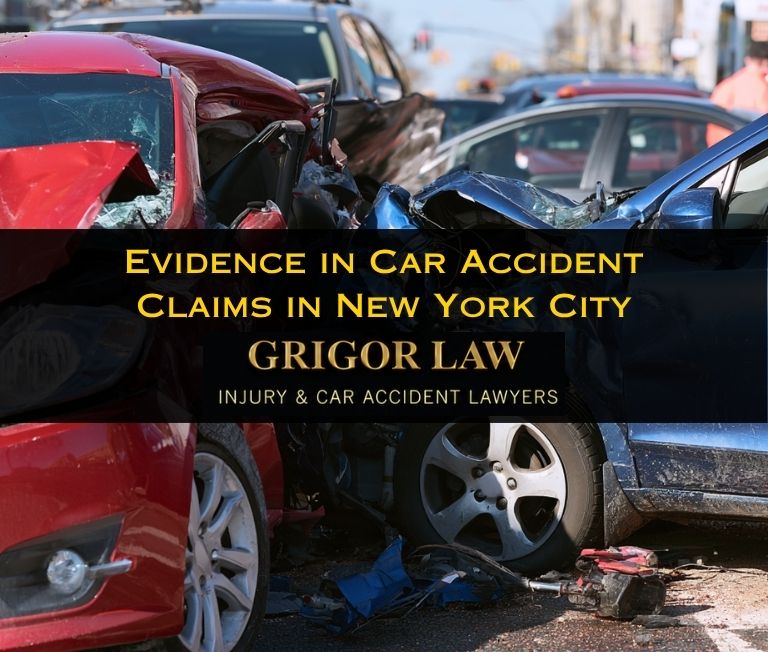
In a New York City car accident claim, the evidence that matters most is your crash scene photos, the NYPD police report, and your medical records.
Witness statements, surveillance footage, and your vehicle’s black box data round out a strong claim, and together they prove who caused the crash and what your losses are worth.
In this article, you will discover every type of evidence you need, the deadlines you cannot miss, and how a Grigor Law car accident attorney in New York City locks down proof before it disappears.
Types of Evidence in NYC Car Accident Claims
Evidence is anything that proves how your crash happened, who caused it, and how badly you were hurt. In New York City, winning a car accident claim comes down to six categories of proof:
- Scene evidence: Photos and videos you capture at the crash site before anything is moved.
- Police accident report: The official NYPD record of the collision, called an MV-104.
- Medical documentation: Records from every doctor, hospital, and therapist who treated you.
- Financial loss proof: Pay stubs, employer letters, and receipts for every out-of-pocket expense.
- Electronic data: Surveillance footage, dashcam video, and your vehicle’s black box.
- Your account: A clear, consistent version of what happened and how your injuries changed your daily life.
Every one of these can make or break your case.
Why Evidence Preservation Matters in NYC Car Crashes
Evidence disappears fast in this city. Skid marks wash away in the rain, surveillance footage is overwritten within days, and witnesses move on.
New York gives you three years to file to bring a personal injury lawsuit, that’s the statute of limitations, the legal deadline to sue. However, the proof you need can disappear within the first 72 hours.
Insurance adjusters know this. They stall on purpose, hoping critical evidence disappears before you can use it.
A pattern we see often in Bronx intersection crashes is a nearby bodega or gas station camera that would have captured the exact moment of impact, but the footage loops and overwrites within a week if nobody sends a preservation request. We identify and contact every camera within view of the crash scene the same day we are retained.
Photos and Videos to Take at the Scene
Your phone is your most powerful tool right after a crash. Before any vehicle is moved, capture:
- All vehicle damage from every angle, including license plates
- The other driver’s insurance card and driver’s license
- Skid marks, road debris, and potholes
- Traffic lights, stop signs, and road markings
- Visible injuries on your body
A video walk-around captures the full scene in a way still photos often miss.
Witness Information and Police Report Essentials
Witnesses disappear the moment they walk away. Get their full name, phone number, and email before they leave, not just a first name.
When the NYPD arrives, they create a Police Accident Report (MV-104) containing driver statements, a crash diagram, and the officer’s notes on contributing factors. This report alone is not always enough to prove fault in court, but it anchors our entire investigation.
What Medical Records and Bills Should You Save?
Medical records prove two things: you were injured, and the crash caused it. See a doctor within 24 to 48 hours, even if you feel fine, soft tissue injuries and concussions often don’t show symptoms right away.
Insurance companies search for treatment gaps, which are unexplained delays or breaks in your care. They use these to argue your injuries aren’t serious. Save every document from every provider:
- Emergency room and ambulance reports
- MRI, X-ray, and CT scan results
- Physical therapy notes and specialist referrals
- Prescription receipts and medical equipment bills
What Proof Do You Need for Lost Wages and Expenses?
Under New York’s no-fault insurance system, your own auto insurer pays your initial economic losses, up to $50,000, regardless of who caused the crash. This includes 80% of your lost wages, up to $2,000 per month.
To collect these benefits, you need documented proof of everything.
Pay Stubs and Employer Letters
Gather your pay stubs from the four to eight weeks before the accident. Get a letter from your employer confirming your job title, pay rate, and the exact days you missed.
If you are self-employed, your tax returns and 1099s are how you prove your lost income.
Out-of-Pocket and Replacement Services
No-Fault also covers necessary costs that pile up during your recovery. Keep receipts for:
- Rideshares and taxis to medical appointments
- Prescription co-pays and medical equipment like braces or crutches
- Home health aides and childcare you needed because of your injuries
- Household help like cleaning or grocery delivery
What Other Evidence Proves Fault in New York City?
Surveillance, Traffic, and Dashcam Footage
Business surveillance footage from bodegas, banks, and apartment buildings is typically overwritten every 7 to 30 days. We canvass the crash area immediately to secure this footage before it disappears.
Dashcam video from your car, a nearby taxi, or a delivery truck can resolve a fault dispute instantly. We subpoena it immediately.
Vehicle Black Box EDR Data
Most modern cars contain an Event Data Recorder (EDR), a chip that logs speed, braking, steering, and impact force in the seconds before a crash. This data can prove the other driver never braked, but it is destroyed the moment the vehicle is repaired or scrapped.
Cell Phone Records and 911 Audio
If you suspect the other driver was texting or on a call, their cell records can prove it. We obtain these through a subpoena, a court order demanding records be turned over, which requires filing a lawsuit. We also pull 911 recordings and dispatch reports, which capture real-time descriptions from the moments right after the crash.
Rideshare and TLC Trip Data
Crashes involving yellow cabs, Ubers, or Lyfts happen constantly in New York City. Records from the Taxi and Limousine Commission (TLC) and rideshare apps can confirm a driver’s speed, route, and history. These companies will not turn this over voluntarily, we must legally demand it.
What we see repeatedly in disputed-fault claims involving rideshare vehicles is a driver’s app data showing a different route or status than what the driver told the responding officer. We subpoena that trip data early, because it often resolves a liability dispute before it ever reaches negotiation.
No-Fault Filing Deadlines in New York
Even with perfect evidence, missing a deadline kills your claim.
| Deadline | Timeframe | What’s Required |
| No-Fault application | 30 days from crash | File NF-2 form with your own insurer |
| Medical bill submission | 45 days from treatment | Bills sent to No-Fault insurer |
| Lost wage claim | 90 days from missed work | Wage verification submitted to insurer |
| Notice of Claim (government) | 90 days from crash | Required before suing any government entity |
| Personal injury lawsuit | 3 years from crash | Final deadline to file in court |
The Government Notice of Claim Deadline
If you were hit by an MTA bus, NYPD vehicle, or any government-owned car, you have only 90 days to file a Notice of Claim. Miss this window and you almost certainly lose your right to sue, regardless of how strong your evidence is.
How Comparative Negligence Affects Your Evidence Strategy
Insurance companies almost always try to shift some blame onto you. This is intentional, it directly reduces what they owe you.
New York follows comparative negligence, which means you can still recover compensation even if you were partly at fault. Your award is simply reduced by your share of blame, unless that share is greater than the other driver’s, a bar that took effect May 26, 2026.
- Example: A jury awards you $100,000 and finds you 20% at fault. You receive $80,000.
Every piece of evidence does double duty: it proves the other driver’s negligence and defends you against attempts to shift blame your way.
Can You Sue Beyond No-Fault for Pain and Suffering?
No-Fault does not cover pain and suffering. To sue the at-fault driver for full compensation, you must prove you suffered a “serious injury” under New York Insurance Law § 5102(d).
Qualifying injuries include:
- A bone fracture
- Significant disfigurement
- Permanent loss of use of a body organ or limb
- Significant limitation of a body function or system
- An injury that prevented normal daily activities for a substantial portion of the early recovery period used to qualify under the “90/180 rule,” but that category was eliminated for lawsuits filed on or after May 26, 2026.
Proving a serious injury requires objective medical evidence, MRI results, physician statements, and range-of-motion tests, gathered from the very start of your treatment.
What Mistakes Can Destroy Your Evidence?
The at-fault driver’s insurer has trained adjusters whose entire job is to find reasons to pay you less.
Recorded Statements to Insurers
The other driver’s adjuster will call within days, acting friendly, and ask to record a statement. You are not legally required to give one. They are trained to get you to say things like “I didn’t see them” or “I feel okay”, then use those words to shrink your claim. Tell them your lawyer will be in touch and contact Grigor Law immediately.
Social Media Pitfalls
- What they look for: A photo of you at a party, at the gym, or on vacation can be used to argue you’re not as injured as you claim.
- What to do: Set every profile to private, stop posting about the accident or your recovery, and do not accept friend requests from people you don’t know.
Do Not Repair Your Damaged Vehicle
Do not fix your car or throw away damaged property until everything has been photographed and inspected. Repairs destroy physical evidence and erase the data stored on the black box.
How We Preserve and Build Your Evidence
The moment you call us, we get to work. We send spoliation letters, formal legal demands ordering businesses, city agencies, and the other driver to preserve all evidence. Destroying evidence after receiving one of these carries serious legal consequences.
We use FOIL requests, Freedom of Information Law demands, to pull government records like NYPD reports, 911 audio, and traffic signal timing logs.
For serious cases, we bring in accident reconstruction experts and medical specialists who turn raw evidence into courtroom proof. This is what forces insurance companies to negotiate, because they know we go to trial.
At Grigor Law Injury & Car Accident Lawyers, we send investigators to the crash scene within 24 to 48 hours to photograph conditions and canvass for surveillance footage. If you can’t travel, we come to you, your home, your hospital room, anywhere across all five boroughs and Long Island.
Award-Winning NYC Car Accident Law Firm
The insurance company started working against you the moment this crash happened. Every hour you wait is footage overwritten and witnesses gone.
At Grigor Law Injury & Car Accident Lawyers, we fight for maximum compensation with a shark attitude, and we are always prepared to take your case to trial if they won’t make it right. You pay no attorney fee unless we win. Contact us for a free consultation.
Frequently Asked Questions
Is a Police Report Enough to Prove Fault in a New York City Car Accident?
A police report is important supporting evidence but is rarely enough on its own. It must be paired with witness statements, photos, and other documentation to establish fault in court.
How Fast Is Surveillance Footage Overwritten in New York City?
MTA bus footage can disappear in as little as 72 hours, and most private business cameras loop every 7 to 30 days. This is why we send legal preservation demands within hours of being hired.
Should I Sign a Medical Authorization for the Insurance Company?
Never sign a broad medical authorization for the other driver’s insurer. They will use it to search your entire medical history for pre-existing conditions to blame your injuries on.
Can I Repair My Car Before the Insurance Inspection?
Do not repair your car until it has been fully inspected and photographed by all parties. Repairs destroy physical evidence and can permanently erase data from the vehicle’s black box.
Can I Still Recover Compensation If I Was Partly at Fault for the Crash?
Yes, in most cases. New York’s comparative negligence rule allows you to recover even if you were partially responsible. Your compensation is reduced by your percentage of fault, not eliminated, unless that fault is greater than the other driver’s, a bar that took effect May 26, 2026.
What Happens If I Was Hit by an MTA or City Vehicle?
You must file a formal Notice of Claim within 90 days of the accident. Missing this deadline almost always bars you from suing the government entity, no matter how clear your evidence is.