(718) 249-7447
 Call Us Now


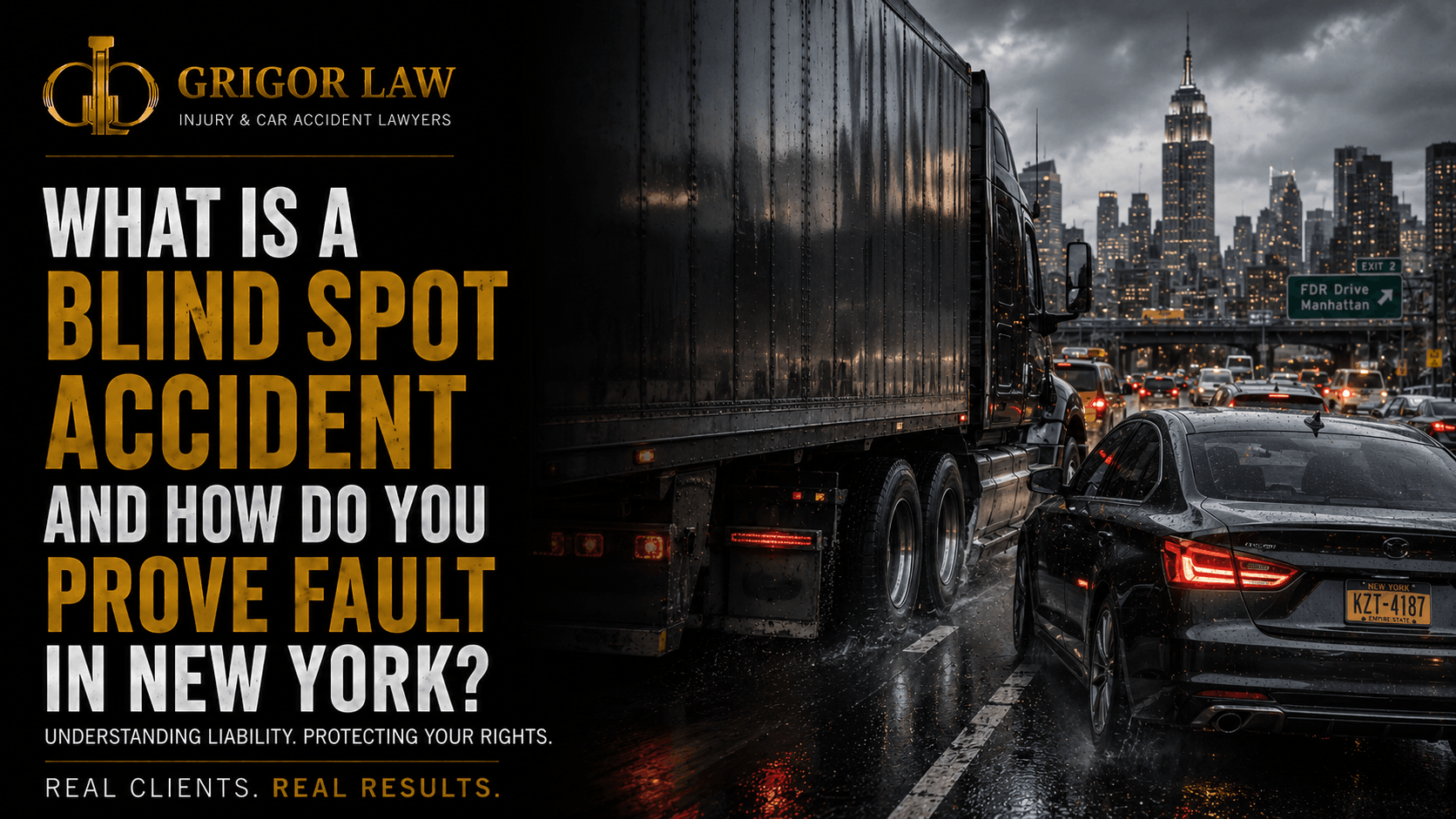
A blind spot accident happens when a driver collides with another vehicle, cyclist, or pedestrian in an area their mirrors cannot reach. In New York, these crashes happen every day on highways like the BQE and LIE, at busy intersections, and on the tight streets of Queens and Brooklyn. The driver who moves without checking is almost always at fault, regardless of where you were positioned on the road.
This article explains how blind spots work on different vehicles, which New York traffic laws apply, and how fault is determined after a crash. You will also learn how no-fault insurance affects your claim, what evidence you need to build your case, and what compensation you may be entitled to recover.
If you were hurt in a blind spot crash, you have legal options and you do not have to figure them out alone.
What Is a Blind Spot Accident?
A blind spot accident happens when a driver hits another vehicle, cyclist, or pedestrian in an area their mirrors and eyes simply cannot see. Every vehicle has these zones, areas around the car where other road users disappear from view entirely.
These crashes are extremely common in New York, where heavy traffic, constant lane changes, and commercial trucks create dangerous conditions on highways like the BQE, LIE, and Cross Bronx Expressway every single day.
Where Are Blind Spots on Cars and Trucks?
Blind spots on a regular passenger car are relatively small, mostly just over each shoulder. Trucks are a completely different story.
Commercial trucks have massive blind zones on all four sides. The Federal Motor Carrier Safety Administration calls these areas “No-Zones,” and they are far larger than most drivers realize:
| Vehicle Type | Front Blind Spot | Rear Blind Spot | Side Blind Spots |
| Passenger car | Minimal | A few feet behind bumper | Over each shoulder |
| Semi-truck | Up to 20 feet | Up to 30 feet | One full lane left, up to three lanes right |
● Front no-zone: A truck driver sitting high in the cab cannot see roughly 20 feet directly ahead. Cutting in front of a semi after passing puts you in serious danger.
● Rear no-zone: Commercial trucks have a substantial blind spot directly behind them. If traffic slows suddenly, the driver may have no idea you are there.
● Side no-zones: The area on a truck’s right side can be a very large blind spot that may extend across multiple lanes. Most sideswipe and merge crashes happen right here.
Who Is at Fault in a Blind Spot Accident in New York?
The driver who changed lanes, merged, or turned without confirming the path was clear is almost always at fault, even if you were sitting in their blind spot at the time.
This is because every driver has a legal duty to check before moving. A blind spot is a known limitation of driving, not a legal excuse for causing a crash.
Fault does not always stop with the driver who hit you. A trucking company can also be held responsible if they failed to install blind spot monitors, skipped required driver training, or let their mirrors fall into disrepair.
Which New York Traffic Laws Apply?
Three specific laws are most relevant in blind spot accident cases in New York. When a driver breaks any of these, it creates a presumption of negligence, meaning the law already leans in your favor.
● VTL § 1128: Requires every driver to stay in their lane until they can change safely.
● VTL § 1163: A turn signal must be used at least 100 feet before any lane change or turn.
● VTL § 1146: Requires drivers to use reasonable care to avoid hitting pedestrians, cyclists, and other vehicles.
Can You Still File a Claim if You Share Some Fault?
Yes. New York follows a rule called pure comparative negligence, which means you can still recover money even if you were partly responsible for the crash.
Here’s how it works in practice: if a truck merged into you while you were driving slightly over the speed limit, a jury might find you 20% at fault, and you would still recover the remaining 80% of your total damages.
Insurance adjusters know this rule well, and they use it against you. They routinely exaggerate your share of fault to shrink their payout. Having a lawyer in your corner stops that from happening.
Common Blind Spot Crash Scenarios in New York
Blind spot crashes follow predictable patterns across the five boroughs, Nassau, and Westchester counties. Recognizing your situation helps you understand your legal options faster.
● Highway sideswipes: A car or truck drifts into an adjacent lane on the BQE, LIE, or Cross Bronx without checking mirrors.
● Wide-turn truck crashes: A semi swings wide right at a city intersection and crushes a smaller vehicle caught beside it.
● On-ramp merge collisions: A driver entering the Belt Parkway fails to yield to traffic already traveling in the lane.
● Motorcycle and bicycle sideswipes: Delivery vans and rideshare drivers clip motorcyclists and cyclists on tight Brooklyn and Queens streets.
● Parking lot backup crashes: SUV and box truck drivers reverse without using rear cameras or checking mirrors.
How Do You Prove Fault After a Blind Spot Crash?
Proving fault means showing the other driver failed to check their mirrors or broke a traffic law before the collision. The evidence you need exists right now, but much of it disappears fast.
Surveillance and dashcam footage is often the strongest proof available. Surveillance footage from NYC DOT and private business cameras can be overwritten, so it’s important to act quickly to preserve it. We send preservation letters immediately to lock this footage down before it is gone.
Vehicle damage patterns tell a clear story on their own. The exact location of damage on each car shows investigators who moved into whose lane, often without a single witness needed.
The truck’s black box, formally called an event data recorder (EDR), captures speed, braking, and steering data at the exact moment of impact. Combined with the driver’s hours-of-service logs, this evidence can prove fatigue or distraction before the crash even began.
Witness accounts matter enormously, and memories fade fast. We canvass the scene quickly to find and interview anyone who saw what happened while the details are still sharp.
Medical records are just as important as crash evidence. New York requires victims to meet a “serious injury threshold” to sue beyond basic insurance limits, which means detailed documentation from your very first doctor’s visit is essential to your case.
What Injuries Are Common in These Crashes?
Blind spot collisions with commercial trucks tend to be catastrophic. When a multi-ton vehicle strikes a passenger car from the side, the smaller vehicle absorbs the full force of the impact.
● Whiplash and cervical spine injuries.
● Traumatic brain injuries (TBI) and concussions.
● Spinal cord damage and partial or total paralysis.
● Broken bones from side-impact and sideswipe forces.
● Internal organ injuries from high-impact truck collisions.
● PTSD, anxiety, and lasting emotional trauma.
What Compensation Can You Recover?
You may be entitled to far more than just your immediate medical bills. We fight for every category of damages your case supports.
● Medical expenses: Past and future treatment, surgery, rehabilitation, and prescriptions.
● Lost wages: Income lost during recovery, plus reduced earning capacity if you cannot return to your previous work.
● Pain and suffering: Physical pain, emotional distress, and loss of enjoyment in daily life.
● Property damage: Full repair or replacement of your vehicle.
● Wrongful death damages: For families who lost a loved one, funeral costs, lost financial support, and loss of companionship.
How Does New York’s No-Fault Insurance Affect Your Case?
New York is a no-fault state. This means your own auto insurance, called Personal Injury Protection (PIP), pays your initial medical bills and a portion of lost wages up to $50,000, regardless of who caused the crash.
To sue the at-fault driver for pain and suffering on top of that, your injury must meet the state’s serious injury threshold under Insurance Law § 5102(d). This includes fractures, significant disfigurement, or a permanent physical limitation.
One deadline you cannot miss: you must file your no-fault application (NF-2 form) within 30 days of the crash. Miss that window and you could lose your medical benefits entirely.
How Long Do You Have to File a Lawsuit in New York?
● Personal injury claims: Three years from the date of the crash under CPLR § 214.
● Wrongful death claims: Two years from the date of death.
● Crashes involving city vehicles or MTA buses: A Notice of Claim must be filed within just 90 days.
Do not wait for these deadlines to creep up. Evidence disappears and witnesses move on long before your legal window closes.
Why Hire Grigor Law for Your Blind Spot Accident in New York?
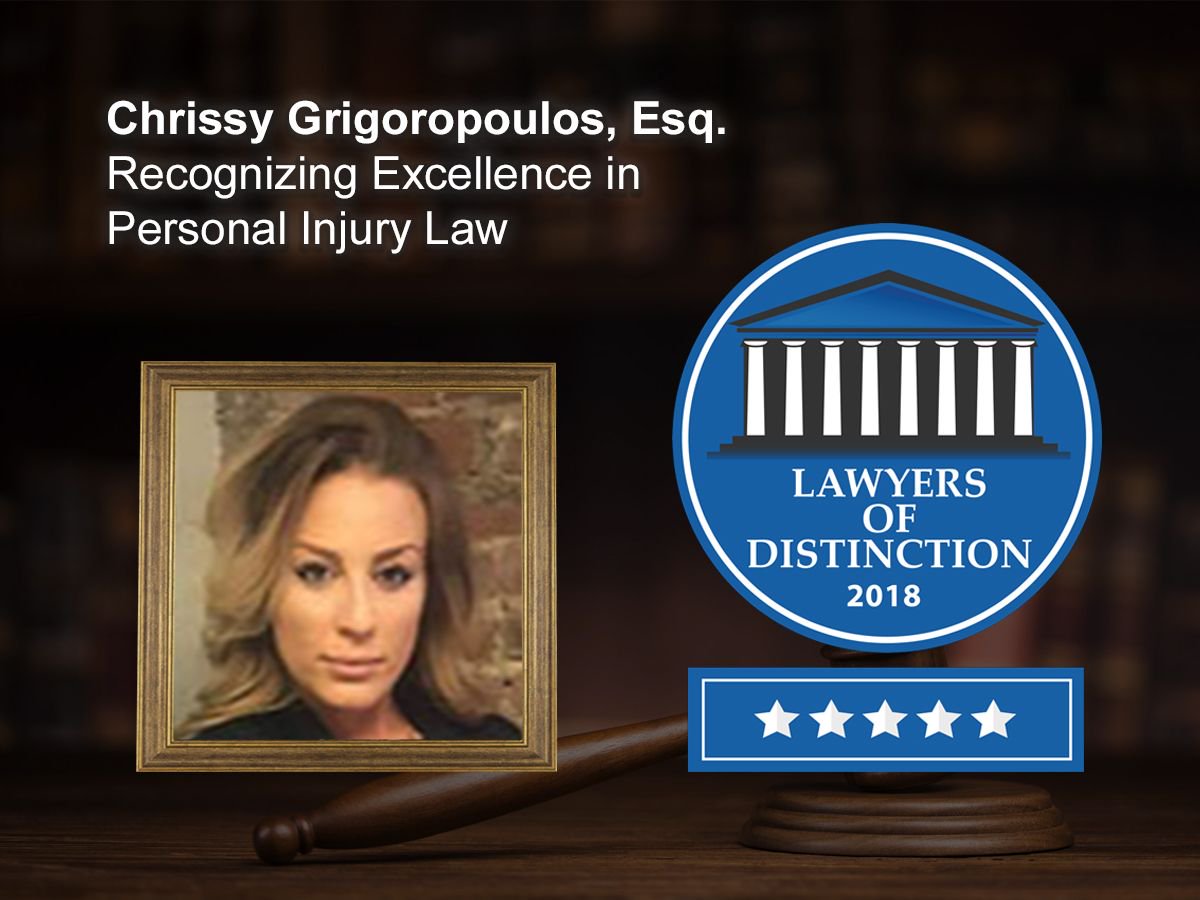
At Grigor Law Injury & Car Accident Lawyers, we know how overwhelming the days after a crash can feel. Founded by Chrissy Grigoropoulos, Esq. recognized as a Top 40 Under 40 Rising Star and one of the American Institute of Personal Injury Attorneys’ 10 Best Female Attorneys for Client Satisfaction, our firm brings fierce advocacy and genuine care to every case we take.
We represent clients across all five boroughs, Nassau, Suffolk, and Westchester counties. Our team speaks English, Spanish, Greek, French-Creole, and Korean, so language is never a barrier to getting the help you deserve.
Consultations are free, we are available 24/7, and you pay nothing unless we win your case. Call (718) 808-9309 or contact us online today to speak with a New York blind spot accident attorney who will fight for every dollar you are owed.
Frequently Asked Questions
Can I Recover Compensation if I Was in a Truck’s No-Zone?
Yes. Being in a truck’s blind spot does not prevent you from filing a claim in New York because drivers have a legal duty to check before changing lanes or turning. Your compensation may be reduced if you share some fault, but you still have a valid case.
Do Blind Spot Warning Systems Affect Who Is at Fault?
Blind spot monitors do not shift legal responsibility away from the driver. If a system was broken or missing, it can actually open up additional claims against the manufacturer or trucking company for failing to maintain safe equipment.
What Counts as a Serious Injury Under New York Law?
A serious injury includes bone fractures, significant disfigurement, permanent loss of a body function, or a medically confirmed injury that prevents normal daily activities for 90 of the first 180 days after the crash.
What Happens if the Vehicle That Hit Me Was City-Owned or an MTA Bus?
You must file a Notice of Claim within 90 days of the accident, and any lawsuit must typically be brought within one year and 90 days. These cases have strict procedural rules, so you should contact a lawyer as soon as possible.
How Quickly Must I Act to Preserve Surveillance Footage?
Traffic cameras, business surveillance systems, and dashcams can overwrite footage quickly, so it’s important to act promptly to preserve recordings. Reaching out to our firm within days of your crash gives us the best chance to send preservation letters and secure that footage before it is deleted permanently.