(718) 249-7447
 Call Us Now


A T-bone accident happens when the front of one vehicle crashes into the side of another, creating the shape of a “T.” In New York, the driver who violated the right-of-way, by running a red light, failing to yield, or making an unsafe turn, is typically at fault.
These crashes cause some of the most serious injuries in any car accident because car doors offer very little protection against direct impact. If you were T-boned in New York, what you do next, and how quickly you do it, directly affects your ability to recover compensation.
This article covers how fault is determined, what New York’s no-fault insurance covers, what evidence you need, and what deadlines apply to your claim.
What Is a T-Bone Car Accident?
A T-bone accident is a side-impact crash where the front of one vehicle slams into the side of another, forming the shape of the letter “T.” This means one driver hits you directly in the door, the part of your car with the least protection.
These crashes happen most often at intersections, but they also occur in parking lots and driveways. You might hear them called different names depending on who you’re talking to:
- Side-impact collision: The term insurance companies and lawyers use most often.
- Broadside crash: Common in police and industry reports.
- Angle collision: How officers sometimes describe it on accident paperwork.
- Passenger-side T-bone: When the impact hits your passenger doors instead of your side.
Why Are T-Bone Crashes So Dangerous?
Car doors and windows offer almost no protection in a crash. Unlike the front or rear of your vehicle, the sides have no crumple zones, meaning there’s nothing to absorb the force before it reaches you.
That’s why T-bone crashes so often cause traumatic brain injuries, spinal cord damage, broken ribs, internal bleeding, and severe whiplash. Because the injuries are often life-altering, figuring out who caused the crash matters enormously for your financial recovery.
Who Is at Fault in a T-Bone Accident in New York?
In most cases, the driver who violated the right-of-way is at fault. This usually means they ran a red light, blew through a stop sign, or made an unsafe left turn. That said, fault isn’t always one-sided, and insurance companies will look hard for any reason to reduce what they pay you.
Here’s how fault typically breaks down depending on the situation:
| Scenario | Typically at Fault |
| Driver runs a red light and hits your side | The driver who ran the light |
| Driver makes a left turn across traffic | The turning driver |
| Driver fails to stop at a stop sign | The driver who failed to stop |
| Both drivers entered the intersection on yellow | Shared fault |
Right of Way, Left Turns, and Red Lights
“Right of way” is the rule that tells drivers who goes first. Oncoming traffic has the right of way over turning vehicles, which is why left turns cause so many T-bone crashes. The turning driver must yield, and when they don’t, they’re usually held responsible.
Running a red light or stop sign is the single most common cause of these crashes. In New York City, red-light cameras at intersections often capture exactly who had the right of way, making them powerful tools for proving fault.
Comparative Negligence in New York
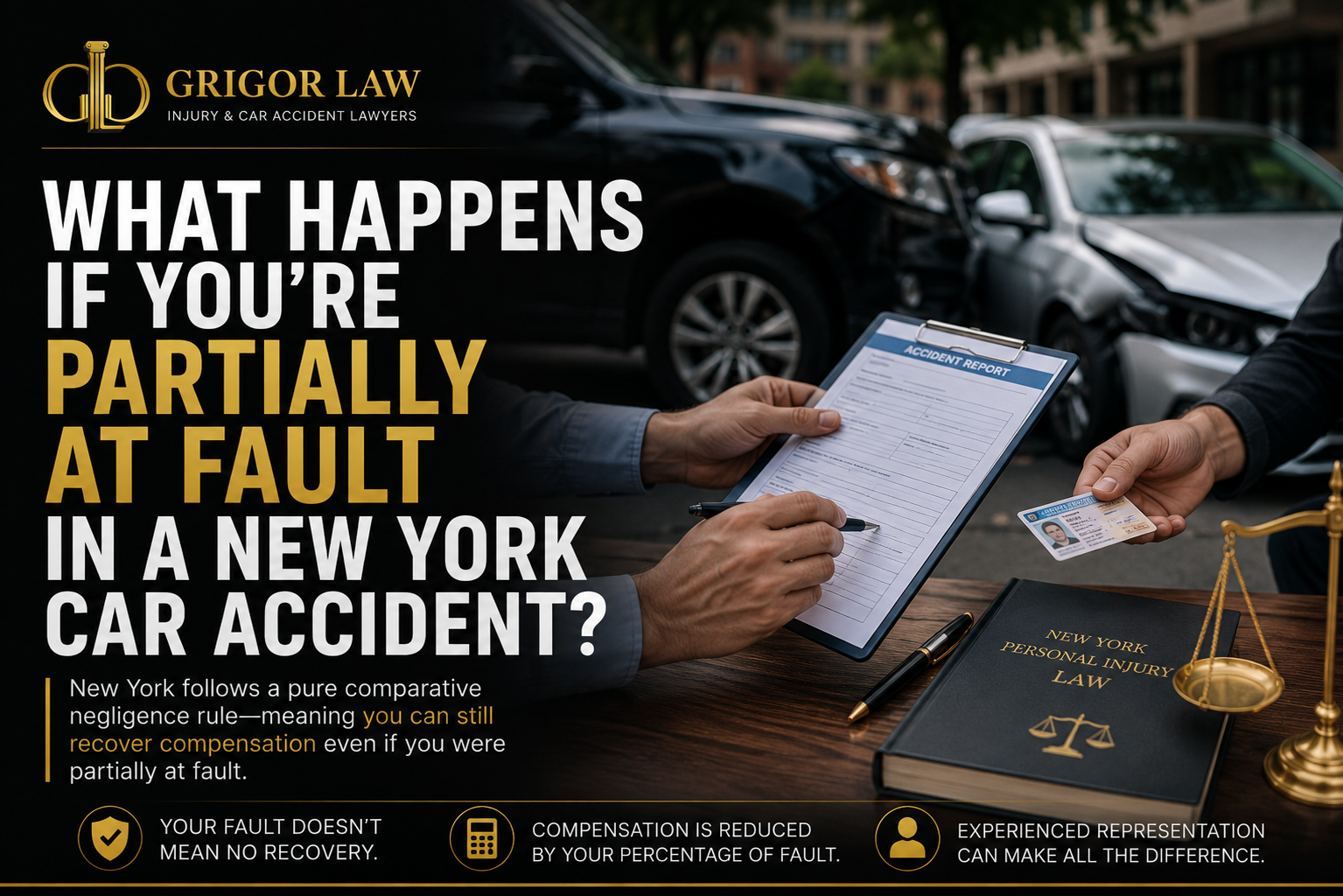
New York follows a rule called pure comparative negligence. This means you can still recover money even if you were partly at fault, your payout is simply reduced by your percentage of blame.
What Evidence Proves Fault in a T-Bone Crash?
At-fault drivers rarely admit what they did. Fault has to be proven, and the steps you take in the first hours after a crash can make or break your case.
At the scene, you should:
- Call 911 immediately to get police and medical help on the way.
- Move to safety only if you can do so without making your injuries worse.
- Say nothing that sounds like an apology, anything you say can be used against you.
- Take photos of both vehicles, the intersection, traffic signals, and your injuries.
- Get names and phone numbers from any witnesses before they leave.
- Seek medical attention right away, even if you feel okay in the moment.
Feeling “fine” after a crash doesn’t mean you’re uninjured. Adrenaline can mask pain for hours or even days, and some injuries, like internal bleeding or concussions, don’t show obvious symptoms right away.
The most important evidence to preserve includes:
- Police report: Documents the crash officially and records any tickets issued.
- Traffic camera footage: Red-light cameras can show exactly who had the right of way.
- Medical records: Connect your injuries directly to the crash, critical for any claim.
- Cell phone records: Can prove the other driver was distracted at the moment of impact.
- Witness statements: Independent accounts that support your version of events.
- Vehicle damage photos: Show the angle and force of impact for accident reconstruction.
Does New York No-Fault Insurance Cover T-Bone Injuries?
Yes, but only up to a point. New York requires all drivers to carry no-fault insurance, also called Personal Injury Protection (PIP). This coverage pays your medical bills and a portion of your lost wages up to $50,000, regardless of who caused the crash.
The catch is that no-fault coverage generally pays medical bills and lost wages but not pain and suffering, so you may need to sue the at-fault driver to recover those damages. To recover more, you need to file a personal injury lawsuit against the at-fault driver, and that requires meeting what’s called the serious injury threshold.
What Counts as a Serious Injury in New York?
The serious injury threshold is the legal standard that lets you sue the at-fault driver for pain and suffering. If your injuries don’t meet it, your recovery is limited to no-fault benefits.
Your injuries qualify if you suffered:
- A bone fracture.
- Significant disfigurement or permanent scarring.
- Permanent loss of use of a body part or organ system.
- Significant limitation of a body function or system.
- An injury that prevented you from performing your normal daily activities for 90 of the first 180 days after the crash.
T-bone crashes, given the force involved, frequently produce injuries that meet this threshold.
What Compensation Can You Recover?
If your case goes beyond no-fault, you may be entitled to both economic and non-economic damages. Economic damages cover your real financial losses. Non-economic damages compensate you for the personal toll the crash has taken on your life.
- Medical expenses: Emergency care, surgery, rehabilitation, and future treatment costs.
- Lost wages: Income you missed during recovery and any long-term reduction in earning capacity.
- Pain and suffering: Physical pain, emotional distress, and a reduced quality of life.
- Property damage: Repair or full replacement of your vehicle and personal belongings.
- Wrongful death damages: Financial support for families who lost someone in the crash.
Every case is different. Settlement amounts depend on the severity of your injuries, how clear the fault is, and the insurance coverage available.
What Are the Deadlines for a T-Bone Accident Claim in New York?
Missing a deadline means losing your right to compensation, permanently. New York enforces strict time limits, and these vary depending on the type of claim you’re filing.
- Within 30 days, file your No-Fault Application (Form NF-2) with your insurer to access PIP benefits.
- 3 years: File a personal injury lawsuit against the at-fault driver.
- 2 years: File a wrongful death claim for a family member who died in the crash.
- 90 days: File a Notice of Claim if a city bus, police vehicle, or other government car caused the crash.
Many people are caught off guard by the 90-day deadline for government vehicle claims. If you were hit by an MTA bus or city-owned vehicle, contact a New York car accident attorney immediately.
What If the Other Driver Was Uninsured or a Government Vehicle Caused the Crash?
- Not every T-bone accident in New York involves a straightforward insurance claim. Some situations are more complex, and require a different legal strategy.
- Uninsured or hit-and-run driver: Your own Uninsured/Underinsured Motorist (UM/UIM) coverage steps in to pay your damages when the at-fault driver has no insurance or flees the scene.
- City buses, NYPD vehicles, or government cars: You can still recover compensation, but the 90-day Notice of Claim deadline applies, and government cases have stricter procedural rules.
- Defective vehicle parts or poor road conditions: If a mechanical failure or a hazardous road contributed to the crash, a manufacturer or government agency may share liability.
These cases are significantly more complex than standard car accident claims, so knowing what kind of lawyer to hire is essential.
Why Grigor Law Fights for T-Bone Crash Victims across New York
Founded by Chrissy Grigoropoulos, Esq. in 2015, Grigor Law Injury & Car Accident Lawyers has built a reputation for fierce advocacy and genuine care for every client. Chrissy has been recognized as a Top 40 Under 40 Rising Star and one of the 10 Best Female Attorneys for Client Satisfaction, and her clients know her as someone who fights hard and communicates honestly.
- Available 24/7: Free consultations, day or night, because emergencies don’t follow business hours.
- No fees unless you win: We work on contingency, so you pay nothing out of pocket to get started.
- Multilingual service: Our team speaks Spanish, Greek, French-Creole, and Korean.
- Citywide reach: We represent clients across all five boroughs of NYC, plus Nassau, Suffolk, and Westchester counties.
If you or someone you love was T-boned in New York, don’t wait. Call our office or submit a form on our website for a free, no-obligation consultation. You pay nothing unless we win your case.
T-Bone Accident FAQs
Can a Passenger File a Claim After a T-Bone Crash?
Yes, passengers can file claims against either or both drivers, and they almost always have the strongest position because they had no control over what happened.
Do You Have to Give the Insurance Company a Recorded Statement?
No. You are not required to give a recorded statement to the other driver’s insurer, and doing so without an attorney can seriously damage your claim.
Is a Red-Light Camera Photo Enough to Prove Fault?
Camera footage is powerful evidence, but insurers and courts also look at police reports, witness statements, and medical records to confirm who was responsible.
Does a Totaled Car Affect Your Injury Claim?
No. Property damage is handled separately from your injury claim and does not reduce what you can recover for medical bills or pain and suffering.
What Does It Cost to Hire Grigor Law Injury & Car Accident Lawyers?
Nothing upfront. The firm works on a contingency fee basis, meaning you pay no legal fees unless your case is successfully resolved.