(718) 249-7447
 Call Us Now


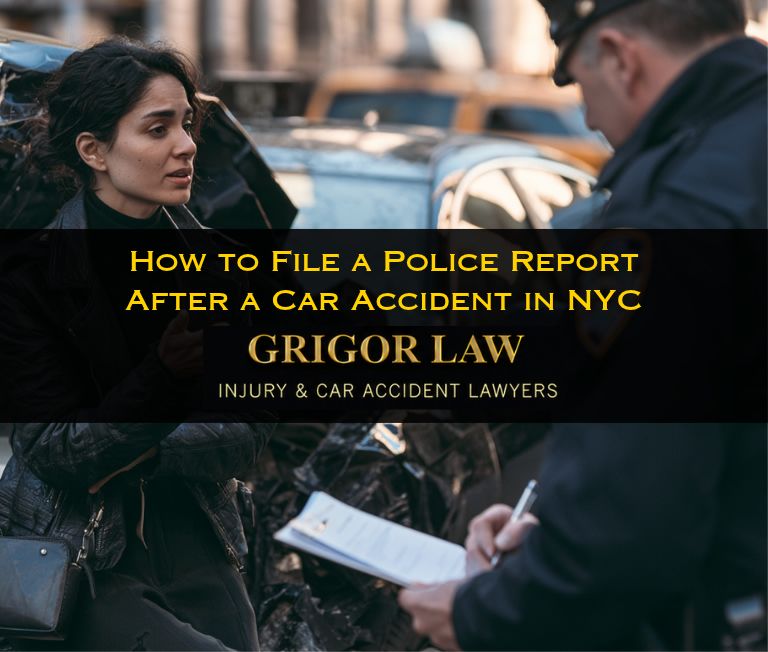
In New York City, you file a police report after a car accident by calling 911 from the scene whenever someone is injured, and officers generate an official collision report.
For property-damage-only crashes, the NYPD generally does not respond, but you must still file the state’s MV-104 form with the DMV within 10 days if damage exceeds $1,000.
In this article, you will discover what the law requires at the scene, how to file and retrieve your report, and how a car crash attorney in New York City can protect your right to compensation.
When Are You Required to Call the Police After a Crash in NYC?
In New York City, you are legally required to call 911 and stay at the scene when a crash involves any injury, death, or harm to a domestic animal. Even when no one appears hurt, a police report is the strongest single piece of evidence you have to protect your right to compensation.
When to Call 911 and Remain at the Scene
New York Vehicle and Traffic Law § 600 sets out exactly when you must stop and wait for police after a crash. Leaving the scene when this law applies can lead to criminal charges.
Call 911 immediately if the accident involves any of the following:
- A person who was injured or killed.
- A domestic animal that was injured or killed.
- Damage to a parked car or property where you cannot find the owner.
- A driver you believe to be intoxicated or uninsured.
What to Do for Property-Damage-Only Collisions in NYC
Since April 2020, the NYPD has not filed reports for crashes involving only property damage. Use the NYPD Collision Information Exchange form to swap license, registration, and insurance details with the other driver at the scene.
What to Do If You Hit Unattended Property or a Domestic Animal
If you strike a parked car and cannot find the owner, you must contact the nearest precinct immediately. Leaving a note with your contact information is not enough. The law requires you to report it directly to the police.
How to File a Police Report in NYC Step by Step
Filing a police report is straightforward, but every step you take, or skip, can affect your case down the road.
Call 911 or File a Walk-In Report at the Precinct
For any crash involving injuries, call 911 and wait for officers to arrive. If police do not respond, go to the precinct closest to where the accident happened and file a report in person.
Exchange Information and Document the Scene
While waiting for officers, or if they do not respond, start gathering your own evidence. This documentation becomes the evidence that supports your insurance claim and any lawsuit.
- Driver information: Name, license number, insurance company, and policy number from the other driver.
- Vehicle details: A photo of the other car’s license plate and VIN (the Vehicle Identification Number, visible on the lower corner of the windshield).
- Scene photos: Damage to both vehicles, skid marks, debris, and any nearby traffic signs or signals.
- Witnesses: Name and phone number of anyone who saw the crash.
- Location: The exact intersection and time of the accident.
Ask for the Report Number and Precinct Details
Before you leave the scene, ask the officer for their name, badge number, and the collision report number. Write it down. That number is how you retrieve your official report later.
Retrieve the Report After the Crash
Your police report is typically available within seven business days through the NYPD’s online portal. You can also visit the precinct of occurrence to request a copy in person for the first 30 days after the accident.
What we see consistently in collision reports from precincts across Queens and Brooklyn is that the narrative section is often short, written quickly at a busy intersection, and sometimes based only on what the first driver to speak told the officer.
A missing witness or a wrong lane description can follow the claim for months. We compare the report against scene photos, 911 records, and nearby camera footage early, so errors can be addressed with a supplemental report while memories are fresh.
Do You Have to File the DMV MV-104 After a Crash in New York?
A police report covers your obligation to law enforcement, but you also have a separate obligation to the state. The MV-104, New York’s Report of Motor Vehicle Accident form, must be filed directly with the New York State Department of Motor Vehicles (DMV).
When MV-104 Is Required and the 10-Day Deadline
You must file an MV-104 if the crash resulted in any injury, death, or property damage over $1,000, even if officers already responded and filed their own report. You have exactly 10 days from the date of the accident.
Key warning: Missing this deadline can result in the DMV suspending your driver’s license, regardless of who caused the crash.
How to Complete and File MV-104 With the DMV
Download the MV-104 from the NYS DMV website, fill it out with details about the drivers, vehicles, and what happened, then mail it to the DMV address listed on the form.
How Do You Get a Copy of Your NYPD Accident Report?
You will need an official copy of the report for your attorney, your insurer, and your personal records. How you request it depends on how much time has passed since the accident.
- Within 30 days: Download the “Request for Copy of Collision Record” form and submit it in person or by mail to the precinct where the report was filed.
- After seven business days: Search for your report on the NYPD Collision Report Retrieval Portal using your report number, accident date, and precinct number.
- After 30 days: NYPD forwards all reports to the NYS DMV. Submit form MV-198C, the ‘Request for Copy of Accident Report,’ directly to the DMV by mail.
What Deadlines Apply After a Car Accident in New York?
The police and DMV report deadlines are only two of the clocks that start ticking the day of your accident. Insurance companies and courts run on entirely separate timelines, and missing any one of them can cost you the right to recover money for your injuries.
| Report or Claim | Who You Notify | Deadline |
| Police report | NYPD | Immediately at the scene |
| MV-104 form | NYS DMV | 10 days from the accident |
| No-fault benefits (NF-2) | Your auto insurer | 30 days from the accident |
| UM/UIM claim | Your auto insurer | 90 days from the accident |
| Personal injury lawsuit | New York courts | 3 years from the accident |
| Claim against NYC or MTA | City or transit authority | 90-day Notice of Claim |
No-Fault Benefits and UM/UIM Claims
New York is a no-fault state, which means your own auto insurer pays your initial medical bills and lost wages regardless of who caused the crash. You have 30 days to file your no-fault application (form NF-2), or your benefits can be denied. If the at-fault driver had no insurance or fled the scene, you must notify your own insurer within 90 days to open an Uninsured/Underinsured Motorist (UM/UIM) claim.
One pattern we consistently see in New York City hit-and-run cases is that the injured driver reports the crash to police but waits weeks to notify their own insurer, assuming the police report is enough. Uninsured motorist claims carry their own notice requirements, and late notice gives the insurer an easy reason to deny coverage.
We send that notice on day one, along with the police report number, so the claim is protected from the start.
What Should You Save to Support Your Claim?
A police report documents the crash, but other records prove what it cost you. Keep everything organized in one dedicated folder from the day of the accident.
- Medical records: ER bills, doctor’s notes, imaging results, and prescription receipts link your injuries directly to the crash.
- Wage records: Pay stubs or an employer letter document the income you lost while you were unable to work.
- Repair estimates: A written estimate for your vehicle’s damage supports the $1,000 property damage threshold for the MV-104.
- Communications log: Write down every date, time, and name each time you speak to an insurance adjuster and note what was said.
- Symptom journal: Daily notes on your pain and physical limitations are powerful evidence of how the accident has changed your life.
The other driver’s insurance company is not on your side. Their adjusters are paid to find statements that damage your case, so do not give a recorded statement to anyone before you speak with an attorney.
What Happens If Your Report Is Late or Has Errors?
A delayed or inaccurate report does not automatically end your case, but it does hand the insurance company a reason to fight back harder.
What to Do If Your Report Is Late or Missing
Missing the 10-day MV-104 deadline can get your license suspended, and missing the 30-day no-fault window can result in denied medical benefits. File your reports as soon as you realize the gap, even if the deadline has passed, and document every reason for the delay.
How to Correct an NYPD Collision Report
If the report lists the wrong street, omits a witness, or misidentifies a vehicle, you can file a supplemental report at the precinct where it was originally taken. An attorney can submit photos, witness affidavits, and medical records alongside the correction to make sure the full picture is on file.
Do You Need a Police Report for an Insurance Claim in New York?
No law requires a police report to file an insurance claim, but your policy almost certainly does. Without one, it becomes your word against the other driver’s, and insurance adjusters are trained to exploit that uncertainty. Filing a report, even after a minor crash, creates an official record that prevents the other driver from changing their story.
“I just wrapped up my case with Chrissy and her team. The experience I had with them was amazing. From the beginning to the end of the case, I was well-informed of the case and where it stood. If I had any questions, her team was very quick to respond. Chrissy is an amazing attorney and you know that she will win this case for you. I recommend everyone who has had an accident to go to her firm.” – Carlos Tuesday
How Grigor Law Protects Your Rights After an NYC Car Accident
After a crash, your job is to recover. Our job is to fight. At Grigor Law Injury & Car Accident Lawyers, our attorneys step in immediately, handling police report retrieval, MV-104 filing, no-fault applications, and all insurer communication so you can focus on healing.
If your injuries make it hard to travel, we come to you. Our offices in Ridgewood, The Bronx, and Hempstead cover all five boroughs, Long Island, and Westchester. Insurance companies know we take cases to a jury verdict, which means we negotiate from a position of strength. We work on contingency, so you pay nothing unless we win.
Call Grigor Law today at (718) 249-7447 for a free consultation.
Frequently Asked Questions
Do I Still Need to File the MV-104 If Police Responded to My Accident?
Yes, the police report and the MV-104 are entirely separate legal obligations, and filing one does not satisfy the other. Missing the 10-day MV-104 deadline can still result in a license suspension even when officers were on the scene.
Can I File an NYPD Police Report Days After a Car Accident?
If police did not respond at the scene, you can go to the precinct of occurrence and file a report in person after the fact. File as early as possible. Delays give the other side more room to dispute your account.
Do Passengers Have to File the MV-104?
Only drivers are required to file the MV-104, but passengers should notify the relevant no-fault insurance carrier within 30 days to protect their own medical and lost wage benefits.
What Should I Do If I Hit a Parked Car and Cannot Find the Owner?
You must attempt to locate the owner before leaving, and if you cannot find them, New York law requires you to notify the nearest police precinct immediately. Driving away, even after leaving a note, can be charged as leaving the scene under VTL § 600.
How Long Until My NYPD Accident Report Appears in the Online Portal?
NYPD states that reports can take up to seven business days from the date of the accident to be processed and uploaded to the Collision Report Retrieval Portal.
Do I Need a Police Report to Collect No-Fault Benefits?
No-fault law does not strictly require a police report to apply for benefits, but your insurer will almost always ask for one before processing your claim. The report is the clearest evidence connecting your injuries to the specific accident.